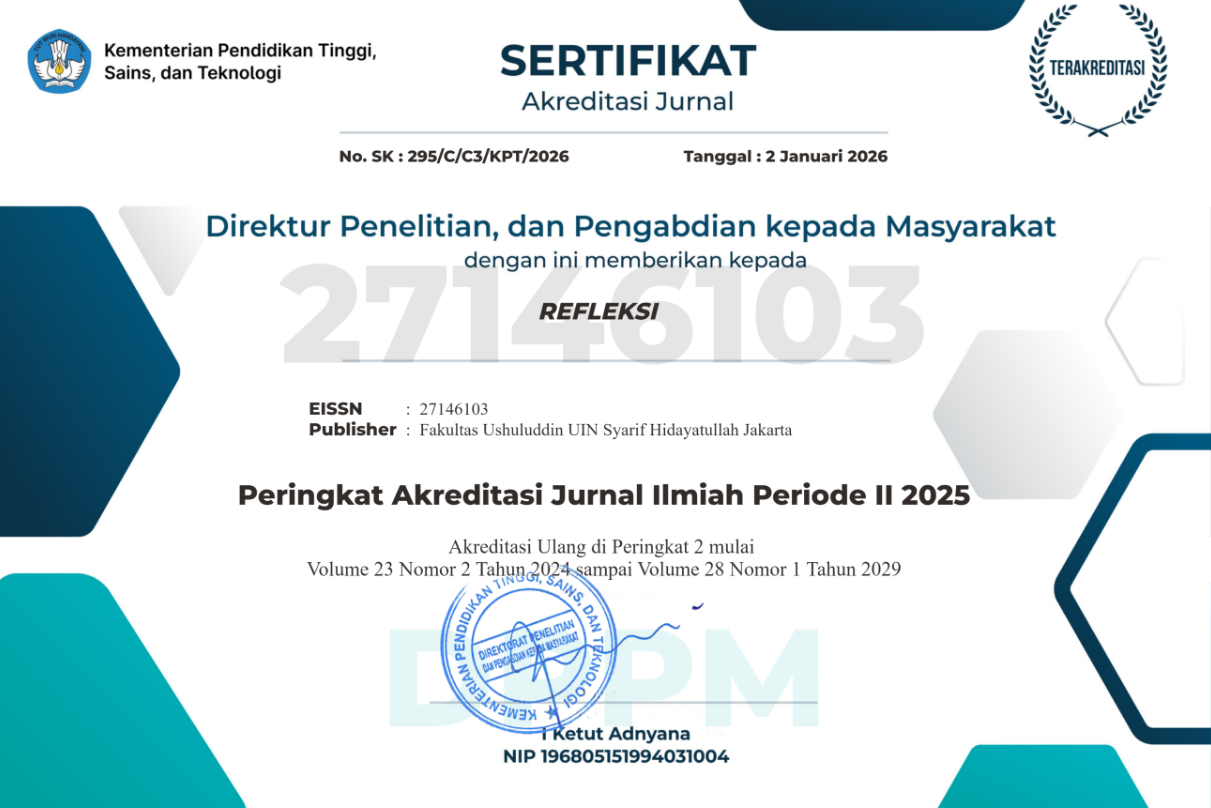
Konsepsi Kearifan Ekologis Ugamo Malim Di Huta Tinggi: Perspektif Seorang Pemimpin Agama
DOI:
https://doi.org/10.15408/refleksi.v25.i2.53463Keywords:
Ugamo Malim, Parmalim, Toba Batak, Ecological Wisdom, Integral Ecology, Indigenous ReligionAbstract
This article examines how ecological meaning is constructed in Ugamo Malim (Parmalim) in Huta Tinggi, North Sumatra, from the perspective of one religious leader. It responds to documented ecological pressures in the Batak region, including forest loss, industrial pollution, conflicts over customary land, and the contested presence of the pulp industry around Lake Toba. Using a qualitative descriptive design, the study combines a literature review with one in-depth interview conducted with a Parmalim religious leader on 1 July 2025. It does not claim to represent all Parmalim members. The available material is read through integral ecology and organized around six connected themes: Debata Mulajadi Nabolon as Creator, humans as part of the earth, limited use of natural resources, care for springs, trees, and forests, relational meanings of land and settlement, and the integration of ecological, social, cultural, economic, spiritual, and intergenerational dimensions. The study argues that these themes form a coherent conceptual relationship between teaching, ritual, self-restraint, and ecological practice, while acknowledging the limits of a single-informant corpus.
References
Arrivabene, Alexandre, Lou Lasic, Julien Blanco, Stéphanie M. Carrière, Ana Ladio, Sophie Caillon, Vincent Porcher, and Irene Teixidor-Toneu. “Ethnobiology’s Contributions to Sustainability Science.” Journal of Ethnobiology 44, no. 3 (2024): 207–20. https://doi.org/10.1177/02780771241261221.
Braun, Virginia, and Victoria Clarke. Thematic Analysis: A Practical Guide. SAGE Publications, 2022.
Ginting, Sadar, Anurak Wongta, Sakaewan Ounjaijean, and Surat Hongsibsong. “Indonesia’s Indigenous Suku Anak Dalam: Knowledge for Food and Environmental Sustainability.” Frontiers in Sustainable Food Systems 9 (2025): 1587094. https://doi.org/10.3389/fsufs.2025.1587094.
Gultom, Ibrahim. Agama Malim Di Tanah Batak. Jakarta: Bumi Aksara, 2010.
Gultom, Rajamarpodang. Dalihan Na Tolu: Nilai Budaya Suku Batak. Medan: Armanda, 1992.
Habeahan, Salman. Dari Imamat Parmalim Ke Imamat Katolik. Jakarta: Obor, 2018.
Hasibuan, Edison. Opini Dan Fakta Di Sekitar Danau Toba: Studi Kasus Peran PT. Inti Indorayon Utama Dalam Industrialisasi. Jakarta: Masyarakat Pencinta Toba-Lestari (MPTL), 2000.
Hastuti, Yuni Puji, Kukuh Nirmala, Manuntun Parulian Hutagaol, Dahri Tanjung, Agit Kriswantriyono, Wildan Nurussalam, Yulia Puspadewi Wulandari, and Yuli Siti Fatma. “Analysis of Main Components of Lake Toba’s Water Quality in Different Seasons.” Advances in Oceanography and Limnology 15, no. 1 (2024). https://doi.org/10.4081/aiol.2024.11726.
Keraf, Sonny. Krisis Dan Bencana Lingkungan Hidup Global. Jakarta: Kanisius, 2010.
Kurniawan, Dwi, and Indra Harahap. “Sipahalima in Parmalim Teachings: An Analysis of Local Spiritual Resilience against the Challenges of Modernization in the City of Medan.” JUSPI: Jurnal Sejarah Peradaban Islam 9, no. 1 (2025): 182–91. https://doi.org/10.30829/juspi.v9i1.24479.
Lamahu, Arafat Iskandar. “Ugamo Malim Dalam Diskursus Keagamaan Di Hutatinggi Kabupaten Toba Samosir.” Jurnal Sosiologi Agama 14, no. 1 (2020): 67–92. https://doi.org/10.14421/jsa.2020.141-05.
Lushombo, Léocadie Wabo. “Ecological Sustainability for ‘Life on Land’: Wellspring of Indigenous Knowledge.” Religions 16, no. 3 (2025): 311. https://doi.org/10.3390/rel16030311.
Malterud, Kirsti, Volkert Dirk Siersma, and Ann Dorrit Guassora. “Sample Size in Qualitative Interview Studies: Guided by Information Power.” Qualitative Health Research 26, no. 13 (2016): 1753–60. https://doi.org/10.1177/1049732315617444.
Manalu, Musdodi Frans Jaswin. “Criminalization and Land Rights Conflict: The Indigenous Struggle against PT Toba Pulp Lestari.” Indigenous Southeast Asian and Ethnic Studies 1, no. 1 (2025): 35–53. https://doi.org/10.32678/iseaes.v1i1.5.
Nadeak, Largus. “Allah Pencipta Hadir Di Sini Bersama Ciptaan-Nya: Refleksi Ekologis Kontekstual.” Logos 15, no. 2 (2019): 67–77. https://doi.org/10.54367/logos.v15i2.321.
Napitu, Ulung, Corry Corry, Hasian Napitu, Ratoga Ambarita, Beresman Sihola, and Friska Panjaitan. “Adaptation of the Toba Batak Community in Conservation of the Lake Toba Environment.” JPPI (Jurnal Penelitian Pendidikan Indonesia) 8, no. 3 (2022): 888–96. https://doi.org/10.29210/020221691.
Ojeifo, Emmanuel Omokugbo. “Integral Ecology as Theology and Ethics of ‘Place.’” Religions 16, no. 6 (2025): 659. https://doi.org/10.3390/rel16060659.
Paus Fransiskus. Evangelii Gaudium. Vatican City: Libreria Editrice Vaticana, 2013. https://www.vatican.va/content/francesco/en/apost_exhortations/documents/papa-francesco_esortazione-ap_20131124_evangelii-gaudium.html.
Purba, Fredi Ardo, and Elsami Castigliani Huka. “Di Bawah Bayang-Bayang Toba Pulp Lestari: Teologi Pembebasan Untuk Memulihkan Ekologi Danau Toba.” Sanctum Domine: Jurnal Teologi 14, no. 1 (2024): 1–20.
Rodenburg, Janet. In the Shadow of Migration: Rural Women and Their Households in North Tapanuli, Indonesia. Leiden: KITLV Press, 1997.
Sandelowski, Margarete. “Whatever Happened to Qualitative Description?” Research in Nursing & Health 23, no. 4 (2000): 334–40. https://doi.org/10.1002/1098-240X(200008)23:4%3C334::AID-NUR9%3E3.0.CO;2-G.
Setiawan, Kodrat Eko Putro, Sarwiji Suwandi, and Retno Winarni. “A Representation of Eco-Theology in Toba Batak Society, Indonesia.” Journal of Law and Sustainable Development 12, no. 1 (2024): e2633. https://doi.org/10.55908/sdgs.v12i1.2633.
Sihite, Ipan, Berliana Simanjuntak, Kaleb E. Simanungkalit, and Dahlia Nopelina Siallagan. “The Value of Ecological Wisdom in the Oral Story of the Toba Batak ‘Tombak Sulu Sulu’: An Ethnographic Study.” Journal La Lifesci 5, no. 5 (2024): 471–82. https://doi.org/10.37899/journallalifesci.v5i5.1666.
Simorangkir, Mangisi Sahala Edison, Togar Nainggolan, John Bidel Pasaribu, and Bungaran Antonius Simanjuntak. Karakter Batak: Masa Lalu, Kini, Dan Masa Depan. Jakarta: Yayasan Pustaka Obor Indonesia, 2015.
Sinaga, Anicetus B. Allah Tinggi Batak-Toba: Transendensi Dan Imanensi. Yogyakarta: Kanisius, 2014.
Sirait, Sangkot. “Spiritual Being in Parmalim Theology of the Batak People in North Sumatra.” HTS Teologiese Studies/Theological Studies 80, no. 1 (2024): a9167. https://doi.org/10.4102/hts.v80i1.9167.
Siregar, D., and Y. Gulo. “Eksistensi Parmalim Mempertahankan Adat Dan Budaya Batak Toba Di Era Modern.” Anthropos: Jurnal Antropologi Sosial Dan Budaya, n.d. https://pdfs.semanticscholar.org/597b/b49276b4075ba3e350bf2206cd5fa99933d8.pdf.
Suharyanto, Agung. “Pusat Aktivitas Ritual Ugamo Malim Di Huta Tinggi Laguboti Toba Samosir.” Jurnal Ilmu Pemerintahan Dan Sosial Politik 4, no. 2 (2016): 182–95.
Whitten, Anthony. The Ecology of Sumatra. Yogyakarta: Gadjah Mada University Press, 1984.
Yusuf, Yusmar, and Reza Irfandi. “Penghayat Kepercayaan Parmalim Batak Toba.” JIIP: Jurnal Ilmiah Ilmu Pendidikan 7, no. 11 (2024): 12975–82.
Zepeda, Carlos. “Integrating the Ethics of Integral Ecologies into Global Environmental Governance.” Journal of Global Ethics 21, no. 1 (2025): 102–13. https://doi.org/10.1080/17449626.2025.2491365.
Downloads
Published
Issue
Section
License
Copyright (c) 2026 Largus Nadeak, Laurentius Tinambunan

This work is licensed under a Creative Commons Attribution 4.0 International License.