
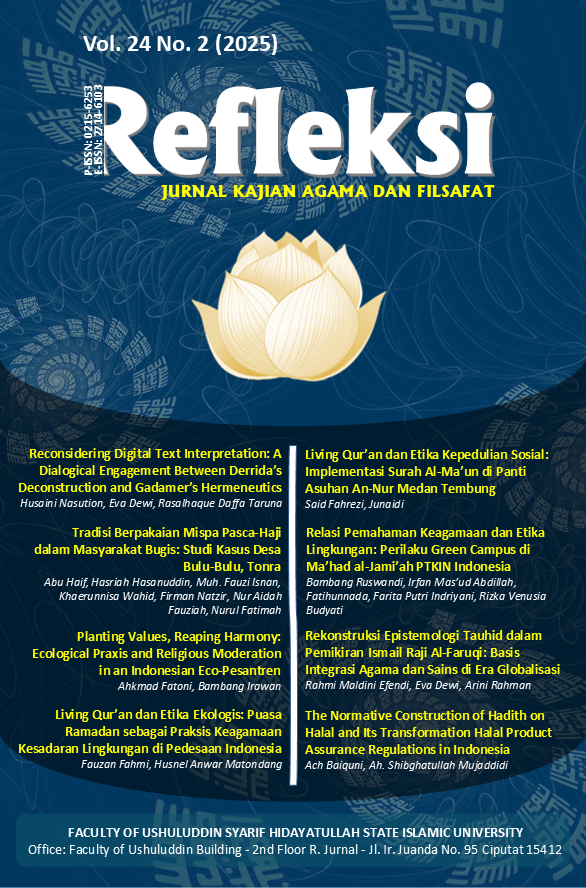
Planting Values, Reaping Harmony: Ecological Praxis and Religious Moderation in an Indonesian Eco-Pesantren
DOI:
https://doi.org/10.15408/refleksi.v24.i2.49798Keywords:
eco-pesantren, ecological praxis, religious moderation, agroecology, interfaith dialogueAbstract
The ecological crisis and increasing social vulnerability caused by climate-related disasters indicate that environmental stewardship cannot be approached solely as a technical agenda, but must also be grounded in value-based and practice-oriented education. This article examines Pesantren Ekologi Ath-Thaariq in West Java as a case of an Indonesian eco-pesantren where ecological praxis serves as a formative medium for religious moderation. Employing a qualitative case-study design, the study draws on field observations, in-depth interviews with eight informants (caretakers, teachers, students, and non-Muslim visitors), and document analysis of the pesantren’s curriculum and interfaith ecological programs. Data were analyzed using reflexive thematic analysis. The findings show that religious moderation at Ath-Thaariq is not primarily transmitted through doctrinal instruction, but emerges as a habitus shaped through ecological labor, everyday ethics of sharing, and action-based interfaith engagement. Programs that frame nature as a shared home “one roof, one air, one earth”, enable participants from different religious backgrounds to collaborate as co-stewards of the environment. This study contributes to discussions on religious moderation by demonstrating how ecological praxis functions as a lived ethical framework that fosters interfaith solidarity and collective responsibility in responding to ecological challenges.
References
Agung, Dewa Agung Gede, Ahmad Munjin Nasih, and Bayu Kurniawan. “Local Wisdom as a Model of Interfaith Communication in Creating Religious Harmony in Indonesia.” Social Sciences & Humanities Open 9 (2024): 100827. https://www.sciencedirect.com/science/article/pii/S259029112400024X.
Al-Jayyousi, Odeh, Evren Tok, Shereeza Mohamed Saniff, Wan Norhaniza Wan Hasan, Noora Abdulla Janahi, and Abdurahman J Yesuf. “Re-Thinking Sustainable Development within Islamic Worldviews: A Systematic Literature Review.” Sustainability 14, no. 12 (2022): 7300. https://elmi.hbku.edu.qa/en/publications/re-thinking-sustainable-development-within-islamic-worldviews-a-s/.
Badan Nasional Penanggulangan Bencana. Data Bencana Indonesia 2024 [PDF]. https://bnpb.go.id/storage/app/media/Buletin%20Info%20Bencana/Buku%20Data%20Bencana%202024/20250613_Buku%20Data%202024.pdf
Baran, Tamer, Cristina Lupu, and Donatella Privitera. “Faith and Sustainability: Exploring Religiosity’s Impact on Intentions to Reduce Food Waste.” Sustainability 16, no. 11 (2024): 4852. https://www.mdpi.com/2071-1050/16/11/4852.
Baxter, Pamela, and Susan Jack. “Qualitative Case Study Methodology: Study Design and Implementation for Novice Researchers.” The qualitative report 13, no. 4 (2008): 544–559. https://nsuworks.nova.edu/tqr/vol13/iss4/2/.
Braun, Virginia, and Victoria Clarke. “Toward Good Practice in Thematic Analysis: Avoiding Common Problems and Be (Com) Ing a Knowing Researcher.” International journal of transgender health 24, no. 1 (2023): 1–6. https://pmc.ncbi.nlm.nih.gov/articles/PMC9879167/.
Bsoul, Labeeb, Amani Omer, Lejla Kucukalic, and Ricardo H Archbold. “Islam’s Perspective on Environmental Sustainability: A Conceptual Analysis.” Social Sciences 11, no. 6 (2022): 228. https://doi.org/10.3390/socsci11060228.
Corpuz, Jeff Clyde G. “Toward Grassroots Interfaith Dialogue: The Role of a Faith-Based Movement.” Religions 16, no. 3 (2025): 345. https://doi.org/10.3390/rel16030345.
Intergovernmental Panel on Climate Change. (2023). Climate Change 2023: Synthesis Report [PDF]. https://www.ipcc.ch/report/ar6/syr/downloads/report/IPCC_AR6_SYR_LongerReport.pdf
Irawan, Bambang. “Islamic Boarding Schools (Pesantren), Sufism and Environmental Conservation Practices in Indonesia.” HTS Teologiese Studies/Theological Studies 78, no. 4 (2022). https://hts.org.za/index.php/hts/article/view/7073.
Mukhibat, Mukhibat, Mukhlison Effendi, Wawan Herry Setyawan, and M Sutoyo. “Development and Evaluation of Religious Moderation Education Curriculum at Higher Education in Indonesia.” Cogent Education 11, no. 1 (2024): 2302308. https://doi.org/10.1080/2331186X.2024.2302308.
National Research and Innovation Agency. “11,3 Million Tons of Garbage in Indonesia Are Mismanaged.” National Research and Innovation Agency. https://brin.go.id/en/news/119838/113-million-tons-of-garbage-in-indonesia-are-mismanaged.
NU Online. Pesantren Ekologi Ath-Thaariq Garut: Terapkan kurikulum bertani dan berkebun (2020, October 18). https://www.nu.or.id/opini/pesantren-ekologi-ath-thaariq-garut-terapkan-kurikulum-bertani-dan-berkebun-7PNB4
Sekretariat Kabinet Republik Indonesia. “Presiden Jokowi Terbitkan Perpres 58/2023 Tentang Penguatan Moderasi Beragama.” https://setkab.go.id/presiden-jokowi-terbitkan-perpres-58-2023-tentang-penguatan-moderasi-beragama/.
Subaidi, Ahmad Tantowi, Nur Cholid, Mahfudz Junaedi, Waluyo, and Mukh Nursikin. “Eco-Pesantren: Islamic Education in Forest Conservation Landscapes.” Fudan Journal of the Humanities and Social Sciences 16, no. 4 (2023): 541–567. https://doi.org/10.1007/s40647-023-00386-w.
Subchi, Imam, Zulkifli Zulkifli, Rena Latifa, and Sholikatus Sa’diyah. “Religious Moderation in Indonesian Muslims.” Religions 13, no. 5 (2022): 451. https://doi.org/10.3390/rel13050451.
Tarrés Vallespí, Anna, Maria Nadeu, and Miquel Àngel Essomba. “Interfaith Dialogue Based on Community Action in Catalonia (Spain): Mapping, Indicators, and Conditions for a Successful Public Policy.” Religions 16, no. 2 (2025): 182. https://doi.org/10.3390/rel16020182.
Tong, Allison, Peter Sainsbury, and Jonathan Craig. “Consolidated Criteria for Reporting Qualitative Research (COREQ): A 32-Item Checklist for Interviews and Focus Groups.” International journal for quality in health care 19, no. 6 (2007): 349–357. https://files.taylorandfrancis.com/pnrh_coreq_checklist.pdf.
Wijaya Mulya, Teguh, and Francesca Salvi. “‘Grass, Rice, and Aubergine’: A Case Study of an Islamic Eco-Pesantren in Indonesia.” Pedagogy, Culture & Society 33, no. 4 (2025): 1437–1455.
Zabidi, Fatin Nur Marhamah, Norshariani Abd Rahman, and Lilia Halim. “Integration of Islamic Values for Environmental Conservation: An Analysis of School Textbooks.” Religions 12, no. 7 (2021): 509. https://doi.org/10.3390/rel12070509.
Zagonari, Fabio. “Religious and Secular Ethics Offer Complementary Strategies to Achieve Environmental Sustainability.” Humanities and Social Sciences Communications 8, no. 1 (2021): 1–13. https://doi.org/10.1057/s41599-021-00802-0.
Downloads
Published
Issue
Section
License
Copyright (c) 2025 Ahkmad Fatoni, Bambang Irawan

This work is licensed under a Creative Commons Attribution 4.0 International License.


