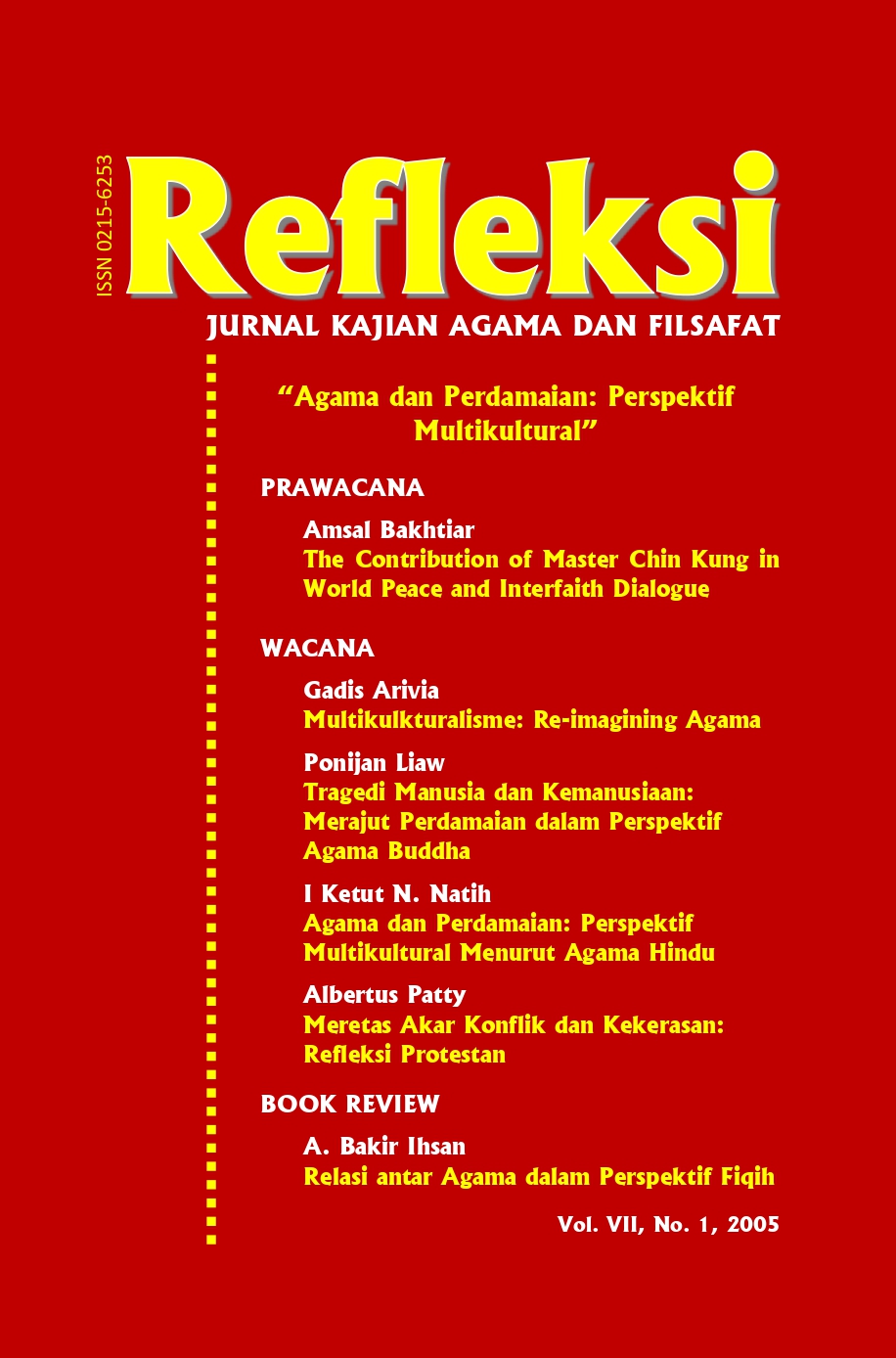
Agama dan Perdamaian: Perspektif Multikultural Menurut Agama Hindu
DOI:
https://doi.org/10.15408/ref.v7i1.25870Keywords:
Religion, Peace, Multiculturalism, Hinduism.Abstract
Through its characters, the essence of Hindu teachings can be found, namely “universalism,” “tattvam asi,” “ahimsa,” “svadhes,” “moksa artham jagat hita ya ca iti dharma,” and so on. Its universality gives rise to the understanding that all religions are the same and true. There is no one religion that is the best and truest. All religions are the same, none is higher, nobler, and more sublime. Hindu teachings and views on religion and peace in a multicultural perspective actually have no problem. In other words, the peace intended can certainly be realized in reality. Because, from the beginning, since around 6000 BC, Hinduism has lived and developed until now, characterized by its universality.
References
Drucker, A. Intisari Bhagavadgita, terj. I Wayan Sadia. Surabaya: Paramita, 1996.
Elisberg, Robrt. Gandhi on Christianity, terj. Lovie Lenny Pristiani & Agung Gunansyah. Yogyakarta: LKiS, 2004.
Vivekananda, Svami. The Complete Works of Svami Vivekananda, Calcutta: Advaita Ashrama, 1984.