Author Guidelines

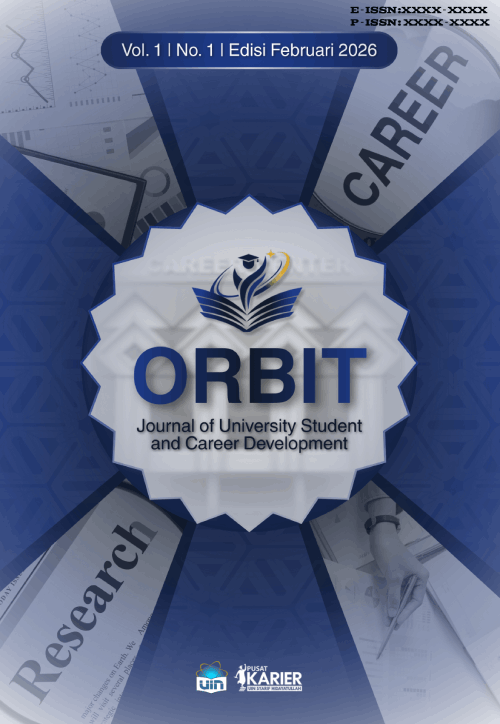
ORBIT: Journal of University Student and Career Development is a peer-reviewed academic journal published by the Career Center of Universitas Islam Negeri (UIN) Syarif Hidayatullah Jakarta. The journal is published biannually and applies a double-blind peer review process. ORBIT publishes original research articles, conceptual papers, and applied studies focusing on student development, career guidance, employability, work readiness, higher education outcomes, and the transition from higher education to the world of work from multidisciplinary perspectives.

Submitted manuscripts must be original, have not been published previously, and must not be under consideration for publication in other journals.

Manuscripts must be prepared using the official ORBIT manuscript template and formatted according to the American Psychological Association (APA) Style, 7th Edition.

ORBIT accepts manuscripts written in English or Bahasa Indonesia. All manuscripts must include abstracts in both English and Bahasa Indonesia.

Manuscripts must be submitted electronically through the ORBIT Online Journal System (OJS).

Manuscript Organization

1. Title

The title must be written in English, concise, informative, and reflect the main focus of the study. The title should not exceed 15 words and must not contain formulas, abbreviations, or symbols.

2. Author(s)

Author names must be written in full without academic titles or degrees. The order of authorship should reflect each author's contribution to the study.

3. Affiliation

Each author must provide a complete institutional affiliation, including institution name, city, country, and a valid correspondence email address.

4. Abstract

The abstract must be written in English and Bahasa Indonesia, each in a single paragraph consisting of 150–250 words. The abstract should briefly describe the background of the study, research objectives, methods, main findings, conclusions, and the scientific or practical contribution of the study. Abstracts should not contain citations, references, tables, or figures.

5. Keywords

Provide three to five keywords in English and Bahasa Indonesia that represent the main concepts of the manuscript. Keywords should be arranged alphabetically and separated by semicolons.

6. Introduction

The introduction should present the research background, literature review, research gap, significance of the study, and research objectives. Authors should clearly demonstrate the contribution of the study to student development, career guidance, employability, work readiness, or higher education outcomes.

7. Methods

The methods section should clearly describe the research design, participants or data sources, instruments, data collection procedures, and data analysis techniques. Sufficient detail should be provided to allow replication of the study.

8. Results and Discussion

This section presents the research findings clearly and systematically. Tables and figures may be used where appropriate. The discussion should interpret the findings, explain their significance, compare them with previous studies, and discuss their implications for theory, practice, or policy.

9. Conclusion

The conclusion should summarize the main findings of the study and highlight its contribution to the relevant field. This section should be concise and should not introduce new information.

10. References

All references must be managed using reference management software such as Mendeley, Zotero, or EndNote and formatted consistently according to APA Style, 7th Edition.

The manuscript should include 15–25 references. Authors are encouraged to use relevant references published within the last ten years. At least 70% of references should be derived from scholarly journal articles.

Tables and Figures

Tables and figures must be numbered consecutively and accompanied by clear titles. Authors must ensure that all tables and figures are referenced in the text. Sources must be provided where applicable.