
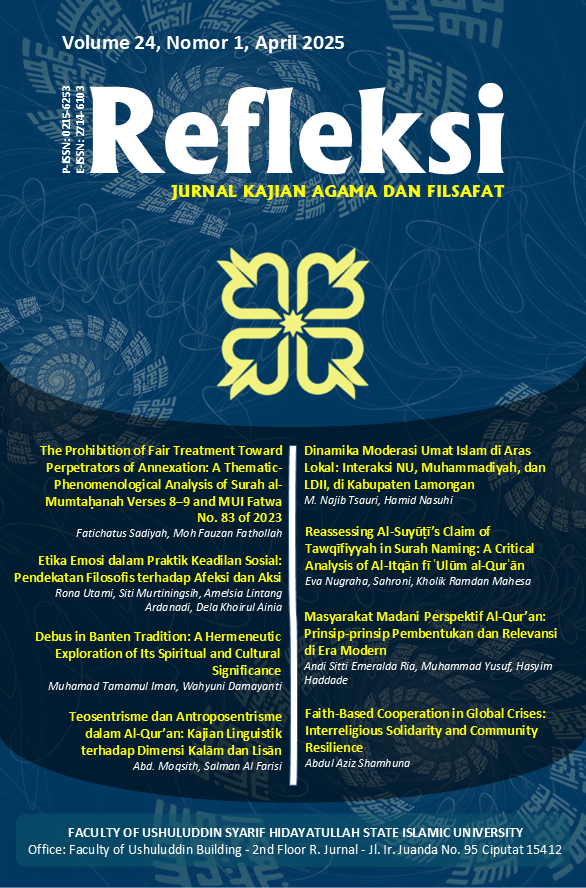
Faith-Based Cooperation in Global Crises: Interreligious Solidarity and Community Resilience
DOI:
https://doi.org/10.15408/refleksi.v24.i1.45867Keywords:
Global Crises, Interreligious Cooperation, Faith-Based Communities, Community Resilience, Interfaith SolidarityAbstract
This study examines how faith-based communities engage in interreligious cooperation during global crises and how such collaboration strengthens community resilience. Using a qualitative approach, the research draws upon case studies, interviews, and surveys involving religious leaders and participants in interfaith initiatives. The analysis highlights that trust, shared moral values, and coordinated collective action function as the primary drivers of successful interreligious engagement. The findings show that these partnerships frequently emerge during urgent humanitarian and healthcare emergencies, where joint efforts improve access to resources and enhance community-level coping strategies. Moreover, interreligious cooperation contributes not only to mitigating crisis impacts but also to promoting a more holistic approach to public welfare. The study underscores that integrating interfaith strategies into crisis management frameworks can reinforce social cohesion, strengthen mutual understanding, and support long-term community development. Overall, this research contributes to the growing academic discourse on interreligious engagement by demonstrating its significance in addressing contemporary global challenges and by emphasizing the need for further exploration of how faith-based dynamics shape social welfare and resilience.
References
Alam, Md. Saiful, Adelina Asmawi, and Sayeda Fatema. “Focus Group Discus-sions (FGDs) for Qualitative and Mixed-Method Approaches: Principles, Appli-cations, and Key Considerations.” Integrated Journal for Research in Arts and Humanities 5, no. 4 (2025): 51–56. https://doi.org/10.55544/ijrah.5.4.8.
Alkhouri, Khader I. “Exploring the Interplay of Cybersecurity Practices and Reli-gious Psychological Beliefs in the Digital Age.” THEOPHANY, Εθνικό και Καποδιστριακό Πανεπιστήμιο Αθηνών, September 5, 2024, Vol 6 (2024). https://doi.org/10.26247/THEOPHANY.2629.
Avelino, Flor, Julia M. Wittmayer, Bonno Pel, et al. “Transformative Social Inno-vation and (Dis)Empowerment.” Technological Forecasting and Social Change 145 (August 2019): 195–206. https://doi.org/10.1016/j.techfore.2017.05.002.
Bielefeld, Wolfgang, and William Suhs Cleveland. “Defining Faith-Based Organi-zations and Understanding Them Through Research.” Nonprofit and Voluntary Sector Quarterly 42, no. 3 (2013): 442–67. https://doi.org/10.1177/0899764013484090.
Corpuz, Jeff Clyde G. “Toward Grassroots Interfaith Dialogue: The Role of a Faith-Based Movement.” Religions 16, no. 3 (2025): 345. https://doi.org/10.3390/rel16030345.
Gordon, Stuart, and Antonio Donini. “Romancing Principles and Human Rights: Are Humanitarian Principles Salvageable?” International Review of the Red Cross 97, nos. 897–898 (2015): 77–109. https://doi.org/10.1017/S1816383115000727.
Harris, Anita, and Joshua Roose. “DIY Citizenship amongst Young Muslims: Ex-periences of the ‘Ordinary.’” Journal of Youth Studies 17, no. 6 (2014): 794–813. https://doi.org/10.1080/13676261.2013.844782.
Hickey-Moody, A. C. “Arts Practice as Method, Urban Spaces and Intra-Active Faiths.” International Journal of Inclusive Education 21, no. 11 (2017): 1083–96. https://doi.org/10.1080/13603116.2017.1350317.
Hołda, Miłosz. “Interreligious Solidarity as a Benefit of Divine Hiddenness—On the Meaning of the Ambiguity of Religious Phenomena.” Religions 14, no. 7 (2023): 866. https://doi.org/10.3390/rel14070866.
Jackson, Robert. “Teaching about Religions in the Public Sphere: European Policy Initiatives and the Interpretive Approach.” Numen 55, nos. 2–3 (2008): 151–82. https://doi.org/10.1163/156852708X283032.
Kadio, Kadidiatou, Denessia Blake-Hepburn, Melodie Yunju Song, et al. “Facilita-tors and Challenges in Collaboration between Public Health Units and Faith-Based Organizations to Promote COVID-19 Vaccine Confidence in Ontario.” International Journal for Equity in Health 23, no. 1 (2024): 254. https://doi.org/10.1186/s12939-024-02326-w.
Lakes, Kimberley D., Elaine Vaughan, Jennifer Pham, et al. “Community Member and Faith Leader Perspectives on the Process of Building Trusting Relationships between Communities and Researchers.” Clinical and Translational Science 7, no. 1 (2014): 20–28. https://doi.org/10.1111/cts.12136.
Liu, Yaoping, and Saichol Chudjuarjeen. “Interreligious Understanding, Social Harmony, and Civic Resilience in a Polarized World.” Journal of Social Innova-tion and Knowledge 2, no. 1 (2025): 1–3. https://doi.org/10.1163/29502683-20250101.
Pascual, Unai, Patricia Balvanera, Christopher B. Anderson, et al. “Diverse Values of Nature for Sustainability.” Nature 620, no. 7975 (2023): 813–23. https://doi.org/10.1038/s41586-023-06406-9.
Payne, Laura. “What Can Faith-Based Forms of Violent Conflict Prevention Teach Us About Liberal Peace?” Religions 11, no. 4 (2020): 167. https://doi.org/10.3390/rel11040167.
Sahin, Abdullah. “Critical Issues in Islamic Education Studies: Rethinking Islamic and Western Liberal Secular Values of Education.” Religions 9, no. 11 (2018): 335. https://doi.org/10.3390/rel9110335.
Seran, Yanuarius. “The Role of Interfaith Dialogue in Enhancing Social Tolerance in Multicultural Communities.” Jurnal Konseling Dan Pendidikan 13, no. 2 (2025): 326–34. https://doi.org/10.29210/1143700.
Tarrés Vallespí, Anna, Maria Nadeu, and Miquel Àngel Essomba. “Interfaith Dia-logue Based on Community Action in Catalonia (Spain): Mapping, Indicators, and Conditions for a Successful Public Policy.” Religions 16, no. 2 (2025): 182. https://doi.org/10.3390/rel16020182.
Wamsler, Christine, Johannes Brossmann, Heidi Hendersson, Rakel Kristjansdot-tir, Colin McDonald, and Phil Scarampi. “Mindfulness in Sustainability Sci-ence, Practice, and Teaching.” Sustainability Science 13, no. 1 (2018): 143–62. https://doi.org/10.1007/s11625-017-0428-2.
Zhu, Yujia. “Religious Beliefs as a Cultural Bridge: Exploring the Role of Interfaith Understanding in Enhancing Diplomatic Relations Across Diverse Cultures.” Lecture Notes in Education Psychology and Public Media 76, no. 1 (2025): 151–63. https://doi.org/10.54254/2753-7048/2024.19626.
Downloads
Published
Issue
Section
License
Copyright (c) 2025 Abdul Aziz Shamhuna

This work is licensed under a Creative Commons Attribution 4.0 International License.


