
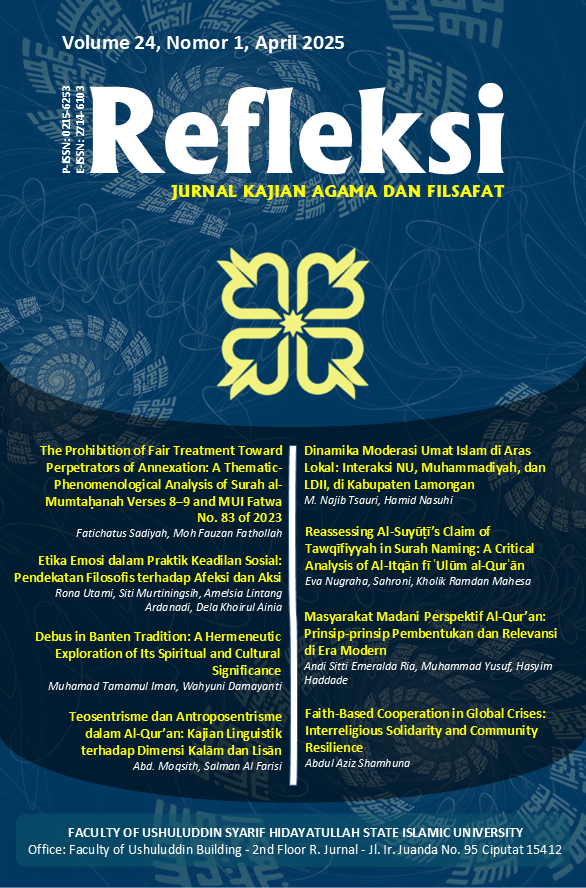
Masyarakat Madani Perspektif Al-Qur’an: Prinsip-prinsip Pembentukan dan Relevansi di Era Modern
DOI:
https://doi.org/10.15408/refleksi.v24.i1.44445Keywords:
Madani Society, Qur’an, Justice, Consultation, Moderation, Civil SocietyAbstract
This article presents an in-depth analysis of the concept of madani society (civil society) from the Qur’anic perspective, understood as an ideal social order founded upon justice, welfare, and democratic values. The study aims to formulate the fundamental principles underlying the formation of a madani society and to underscore their relevance in responding to the challenges of globalization, pluralism, and shifting power dynamics in the modern era. The research employs a qualitative methodology based on library research with a descriptive-thematic (mawḍū‘ī) analytical approach. Primary data are drawn from key Qur’anic verses—Q. al-Nisā’ 58, al-Ḥujurāt 13, al-Shūrā 38, and al-Baqarah 143—supported by authoritative exegetical works by Ibn Kathīr, al-Qurṭubī, and Sayyid Quṭb. The findings indicate that the conceptual blueprint of a madani society is constructed upon four foundational principles: (1) justice as the ethical and legal cornerstone; (2) equality of human dignity, which rejects discrimination and affirms diversity; (3) consultation (shūrā) as a participatory political mechanism to prevent authoritarianism; and (4) moderation (ummatan wasaṭan) as a moral and spiritual framework. The study argues that these principles position madani society as an essential counter-power through the implementation of amr bi al-ma‘rūf wa nahy ‘an al-munkar as a form of social accountability. Consequently, the Qur’anic conception of madani society offers not only a theoretical framework but also an ethical-operational foundation for establishing a just, harmonious, and inclusive social order in contemporary contexts.
References
al-Bouti, Muhammad Sa’id Ramadhan. Tafsir Al-Qur’an Al-Karim. Damaskus: Dar al-Fikr. 2003.
Al-Gazali, Imam. Iḥyā’ ‘Ulūm al-Dīn. Beirūt:Dār al-Kutūb al-’Ilmiyyah, 1996.
al-Maududi, Abul A’la. The Meaning of the Qur’an. Lahore: Islamic Publications, 1967.
Al-Mawdudi. The Islamic Way of Life. Lahore: Islamic Publications, 1986.
al-Qaradawi, Yusuf. The Role of Values in Society. Leicester: Islamic Foundation. 1985.
Al-Qurṭubī, Al-Jāmi’ li Aḥkām al-Qur’an. Kairo: Dar al-Kutub al-Misriyah. 1964.
Aminah, S. Sadli. Civil Society and the New Politics of Development in Indonesia. Penerbit Universitas Indonesia: Jakarta, 2001.
Castells, Manuel. Communication Power. Oxford University Press, Oxford, 2009.
Esposito, John L. Islam and Politics. New York: Syracuse University Press, 1984.
Held, David. Models of Democracy. Stanford University Press, Stanford. 1995.
Ilma, Mughniatul, and Rifqi Nur Alfian. "Konsepsi masyarakat madani dalam bingkai pendidikan Islam." MA'ALIM: Jurnal Pendidikan Islam 1.01 (2020): 25-46.
Iqbal, Muhammad. The Reconstruction of Religious Thought in Islam. Lahore: Ashraf Press, 1930.
Kathīr, Ibnu. Tafsir Al-Qur’an al-Azhim. Dar al-Fikr, Beirut, 1999.
Madjid, Nurcholish. Islam, Kemodernan, dan Keindonesiaan. Bandung: Mizan, 1995.
Muhammad, Nurdinah. "Masyarakat Madani dalam Perspektif Al-Qur'an." Jurnal Ilmiah Al-Mu'ashirah: Media Kajian Al-Qur'an dan Al-Hadits Multi Perspektif 14.1 (2017): 20-30.
Mu'iz, Dzikrul Hakim Tafuzi, and Uril Bahruddin. "Formulasi moderasi beragama dalam pemikiran Yusuf al-Qardhawi sebagai basis mewujudkan masyarakat madani." Al-Mubin: Islamic Scientific Journal 6.1 (2023): 47-57.
Mustaniruddin, Ahmad, Hery Afriyadi, and Jamilah Abu Bakar. "Indikator terciptanya masyarakat madani perspektif Al-Qur’an." TAJDID: Jurnal Ilmu Ushuluddin 19.2 (2020): 164-187.
Nasution, Harun, Islam Ditinjau dari Berbagai Aspeknya. Jakarta: UI Press, 1985.
Nawiruddin. “Masyarakat Madani: Sebuah Keniscayaan”. Refleksi: Jurnal Kajian Agama dan Filsafat 6, no. 3 (December 1, 2004): 369–388. Accessed December 11, 2025. https://journal.uinjkt.ac.id/refleksi/article/view/37875.
Quṭb, Sayyid. Fī Zhilāl al-Qur’ān. Jilid 2. Kairo:Dar al-Shuruq, 1972.
Ridho, Abdul Rasyid. "Peran Komunikasi Profetik Dalam Mewujudkan Masyarakat Madani Perspektif Al-Qur’an." el-Umdah 4.2 (2021): 139-158.
Said, Edwar. Orientalism. Pantheon Books: New York. 1978.
Schumacher, E. F. Small is Beautiful: A Study of Economics as if People Mattered. Harper & Row: New York, 1973.
Shihab, M. Quraish. Tafsir Al-Mishbah: Pesan, Kesan, dan Keserasian Al-Qur’an. Jakarta: Lentera Hati, 2002.
Shihab, M. Quraish. Wawasan Al-Qur’an: Tafsir Tematik Atas Pelbagai Persoalan Umat. Bandung: Mizan, 2007.
Wahid, Abdurrahman. Islam dan Masyarakat Madani. Yayasan Wakaf Paramadina. Jakarta, 1999.
Yafie, Ali. Merintis Fiqh Lingkungan Hidup. Mizan; Bandung, 2006.
Downloads
Published
Issue
Section
License
Copyright (c) 2025 Andi Sitti Emeralda Ria, Muhammad Yusuf, Hasyim Haddade

This work is licensed under a Creative Commons Attribution 4.0 International License.


