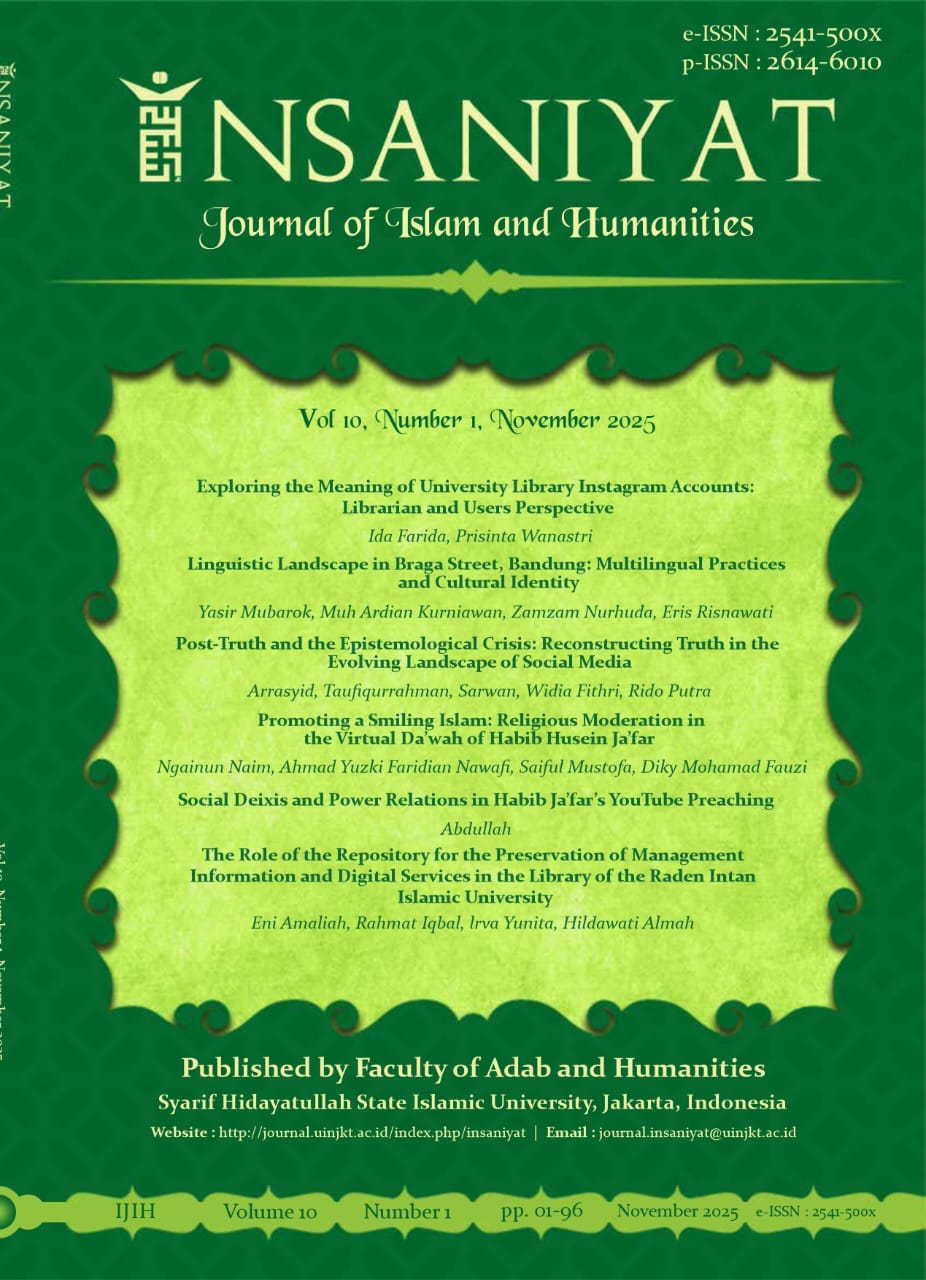
Exploring the Meaning of University Library Instagram Accounts: Librarian and Users Perspective
DOI:
https://doi.org/10.15408/insaniyat.v10i1.46785Keywords:
Academic Libraries, Digital Communication, Instagram Account, Meaning and Interpretation, User EngagementAbstract
This study explores the meaning of two Instagram accounts of Academic Library; the UIN Sunan Kalijaga Yogyakarta and the University of Indonesia, focusing on their posts and engagement. A qualitative phenomenological approach was used to collect data through semi-structured interviews with librarians who manage the accounts and their users who follow the accounts. Instagram has become a central platform for communication and promotion in academic libraries, as evidenced by the University of Indonesia (UI) and UIN Sunan Kalijaga. They use it to share service-related information, document library activities, and encourage student engagement. UI manages its accounts through a centralized system, while UIN uses a collaborative model. However, both institutions emphasize inter-unit coordination and developing librarians' digital design and public communication skills. Despite its potential, Instagram faces several challenges in the library context. These include limited content diversity, low response rates to direct messages, and inadequate visual design skills among account managers. These limitations hinder the platform's ability to meet students' information needs effectively and diminish its capacity to build emotional connections with users. Furthermore, librarians often perceive Instagram as a formal institutional tool, limiting its communicative flexibility and user-centric appeal. To address this, a more humanistic content strategy combining storytelling, an interactive carousel format, and participatory features is needed. This approach would enable more dynamic, two-way communication, increase user engagement, and strengthen the library's image as an inclusive, responsive, and digitally relevant space within the academic community.
References
Al-Daihani, S. M., & Abrahams, A. (2018). Analysis of Academic Libraries’ Facebook Posts: Text and Data Analytics. The Journal of Academic Librarianship, 44(2), 216–225. https://doi.org/10.1016/j.acalib.2018.02.004
Al-Daihani, S. M., & AlAwadhi, S. A. (2015). Exploring academic libraries’ use of Twitter: A content analysis. The Electronic Library, 33(6), 1002–1015. https://doi.org/10.1108/EL-05-2014-0084
Anderson, M., & Jiang, J. (2018, May 31). Teens, Social Media and Technology 2018. Pew Research Center. https://www.pewresearch.org/internet/2018/05/31/teens-social-media-technology-2018/
Atiq, M., Abid, G., Anwar, A., & Ijaz, M. F. (2022). Influencer Marketing on Instagram: A Sequential Mediation Model of Storytelling Content and Audience Engagement via Relatability and Trust. Information, 13(7), 345. https://doi.org/10.3390/info13070345
Chan, T. T. W., Lam, A. H. C., & Chiu, D. K. W. (2020). From Facebook to Instagram: Exploring user engagement in an academic library. The Journal of Academic Librarianship, 46(6), 102229. https://doi.org/10.1016/j.acalib.2020.102229
Chatten, Z. (2017). Making social media work: Finding a library voice. Insights the UKSG Journal, 30(3), 51–61. https://doi.org/10.1629/uksg.374
Cheng, W. W. H., Lam, E. T. H., & Chiu, D. K. W. (2020). Social media as a platform in academic library marketing: A comparative study. The Journal of Academic Librarianship, 46(5), 102188. https://doi.org/10.1016/j.acalib.2020.102188
Chiang, I.-P., Wong, R., & Huang, C. (2019). Exploring the Benefits of Social Media Marketing for Brands and Communities. International Journal of Electronic Commerce Studies, 10(2), 113–140. https://doi.org/10.7903/ijecs.1547
Choi, N., & Joo, S. (2021). Understanding public libraries’ challenges, motivators, and perceptions toward the use of social media for marketing. Library Hi Tech, 39(2), 352–367. https://doi.org/10.1108/LHT-11-2017-0237
Connaway, L. S., & Radford, M. L. (2017). Research methods in library and information science (Sixth). Libraries Unlimited.
Creswell, J. W., & Creswell, J. D. (2023). Research design: Qualitative, quantitative, and mixed methods approaches (6th ed.). SAGE Publications, Inc.
Drivas, I., & Vraimaki, E. (2024). Unveiling the feed: Academic libraries’ instagram unpacked. The Journal of Academic Librarianship, 50(5), 102924. https://doi.org/10.1016/j.acalib.2024.102924
Fong, K. C. H., Au, C. H., Lam, E. T. H., & Chiu, D. K. W. (2020). Social network services for academic libraries: A study based on social capital and social proof. The Journal of Academic Librarianship, 46(1), 102091. https://doi.org/10.1016/j.acalib.2019.102091
Gruzd, A., Lannigan, J., & Quigley, K. (2018). Examining government cross-platform engagement in social media: Instagram vs Twitter and the big lift project. Government Information Quarterly, 35(4), 579–587. https://doi.org/10.1016/j.giq.2018.09.005
Harrison, A., Burress, R., Velasquez, S., & Schreiner, L. (2017). Social Media Use in Academic Libraries: A Phenomenological Study. The Journal of Academic Librarianship, 43(3), 248–256. https://doi.org/10.1016/j.acalib.2017.02.014
Hild, K. L. (2014). Outreach and Engagement through Instagram: Experiences with the Herman B Wells Library Account. Indiana Libraries, 33(2), 30–32.
Ihejirika, K. T., Goulding, A., & Calvert, P. (2021). Rethinking Academic Library Use of Social Media for Marketing: Management Strategies for Sustainable User Engagement. Journal of Library Administration, 61(1), 58–85. https://doi.org/10.1080/01930826.2020.1845547
Jackson, D. (2015, October 12). Twitter vs. Instagram: Which is Best for Your Brand. Sprout Social. https://sproutsocial.com/insights/twitter-vs-instagram/
Jones, M. J., & Harvey, M. (2019). Library 2.0: The effectiveness of social media as a marketing tool for libraries in educational institutions. Journal of Librarianship and Information Science, 51(1), 3–19. https://doi.org/10.1177/0961000616668959
Joo, S., Choi, N., & Baek, T. H. (2018). Library marketing via social media: The relationships between Facebook content and user engagement in public libraries. Online Information Review, 42(6), 940–955. https://doi.org/10.1108/oir-10-2017-0288
KhosraviNik, M. (2022). Digital meaning-making across content and practice in social media critical discourse studies. Critical Discourse Studies, 19(2), 119–123. https://doi.org/10.1080/17405904.2020.1835683
Lam, A. H. C., Ho, K. K. W., & Chiu, D. K. W. (2023). Instagram for student learning and library promotions: A quantitative study using the 5E Instructional Model. Aslib Journal of Information Management, 75(1), 112–130. https://doi.org/10.1108/AJIM-12-2021-0389
Lam, E. T. H., Au, C. H., & Chiu, D. K. W. (2019). Analyzing the use of Facebook among university libraries in Hong Kong. The Journal of Academic Librarianship, 45(3), 175–183. https://doi.org/10.1016/j.acalib.2019.02.007
Marwiyah, M., & Zain, L. (2023). Reaching Users Through Social Media: A Case Study on the Use of Instagram by Islamic Higher Education Libraries in Indonesia. University Library at a New Stage of Social Communications Development. Conference Proceedings, 8, 136–145. https://doi.org/10.15802/unilib/2023_293542
Nguyen, L. C. (2015). Establishing a Participatory Library Model: A Grounded Theory Study. The Journal of Academic Librarianship, 41(4), 475–487. https://doi.org/10.1016/j.acalib.2015.03.018
Nguyen, M. (2023). Use of Social Media by Academic Libraries in Australia: Review and a Case Study. Journal of the Australian Library and Information Association, 72(1), 75–99. https://doi.org/10.1080/24750158.2023.2168465
Okuonghae, O. (2021). Digital content creation: An emerging role for librarians. Library Hi Tech News, 38(3), 16–17. https://doi.org/10.1108/LHTN-11-2020-0109
Rachman, Y. B. (2020). Examining academic libraries’ use of instagram. College & Undergraduate Libraries, 27(2–4), 462–473. https://doi.org/10.1080/10691316.2021.1915221
Rachman, Y. B., Mutiarani, H., & Putri, D. A. (2018). Content Analysis of Indonesian Academic Libraries’ Use of Instagram. Webology, 15(2), 27–37.
Springen, K. (2019). Library-stagrams: Librarians are harnessing Instagram for promotion, professional development, and fun. The Publishers Weekly, 46–50.
Suharso, P., & Pramesti, A. N. (2020). Promosi Perpustakaan Melalui Instagram: Studi di Perpustakaan Universitas Airlangga. Publication Library and Information Science, 3(2), 66. https://doi.org/10.24269/pls.v3i2.2074
T A, Y., Kumar, A., & Ihejirika, K. T. (2023). More user engagement, better for libraries: Proposing a framework for social Media integration in libraries. Information Development, 02666669231191074. https://doi.org/10.1177/02666669231191074
Ting, H., Ming, W. W. P., Run, E. C. de, & Choo, S. L. Y. (2015). Beliefs about the Use of Instagram: An Exploratory Study. International Journal of Business and Innovation, 2(2), 15–31.
Trunfio, M., & Rossi, S. (2021). Conceptualising and measuring social media engagement: A systematic literature review. Italian Journal of Marketing, 2021(3), 267–292. https://doi.org/10.1007/s43039-021-00035-8
Wildemuth, B. M. (Ed.). (2017). Applications of social research methods to questions in information and library science. Libraries Unlimited.
Young, S. W. H., & Rossmann, D. (2015). Building Library Community Through Social Media. Information Technology and Libraries, 34(1), 20–37. https://doi.org/10.6017/ital.v34i1.5625
Downloads
Published
Issue
Section
License
Copyright (c) 2025 Ida Farida, Prisinta Wanastri

This work is licensed under a Creative Commons Attribution-ShareAlike 4.0 International License.