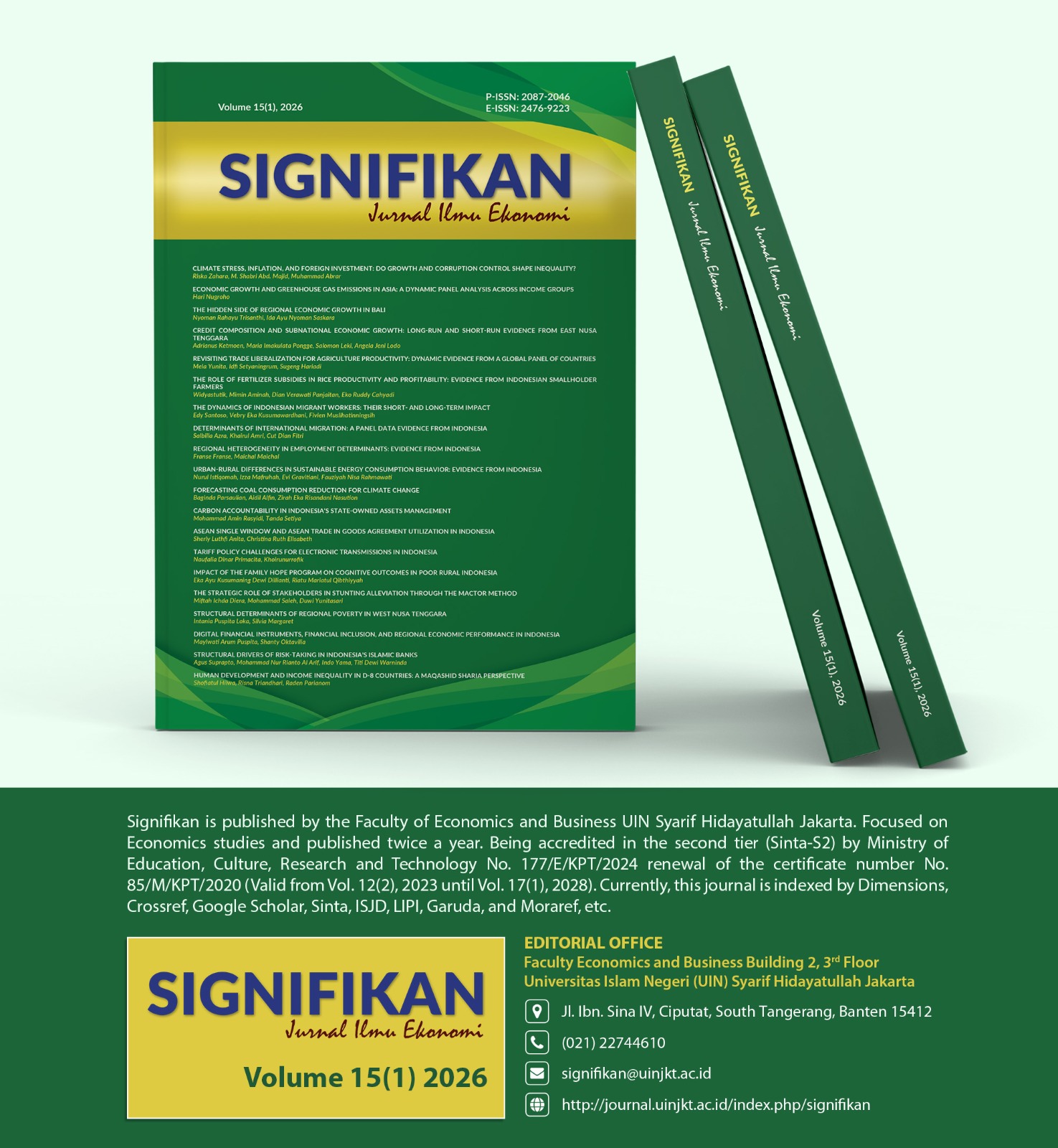
The Role of Fertilizer Subsidies in Rice Productivity and Profitability: Evidence from Indonesian Smallholder Farmers
DOI:
https://doi.org/10.15408/sjie.v15i1.50435Keywords:
inputs, profit, production, welfareAbstract
Research Originality: This study provides micro-level evidence on the dual effects of fertilizer subsidies on rice farmers’ production and profitability, a dimension rarely examined simultaneously at the household level in Indonesia. Using data from two contrasting rice-producing regions, the study isolates subsidy effects on both physical output and farm profit while controlling for input costs and price conditions.
Research Objectives: To analyze the effects of fertilizer subsidies on rice production and farm profit in Karawang (West Java) and Lombok (West Nusa Tenggara).
Research Methods: OLS regression was applied to cross-sectional data from 51 rice-farming households. Two models were estimated: a production function and a profit function.
Empirical Results: Fertilizer quantity, land size, and labor positively influence rice production. Farm profit is significantly affected by production quantity, rice price, total cost, and pesticide cost. Fertilizer cost is not a significant determinant of profit.
Implications: Fertilizer quantity, not cost, drives production. Subsidies should be maintained but reoriented toward targeted, quantity-based schemes and improved distribution efficiency to maximize welfare impact.
JEL Classification: Q12, Q18, D24, I32
References
Adhikary, P. P., Mohanty, S., Rautaray, S. K., Manikandan, N., & Mishra, A. (2023). Alternate Wetting and Drying Water Management can Reduce Phosphorus Availability Under Lowland Rice Cultivation Irrespective of Nitrogen Level. Environmental Monitoring and Assessment, 195(12), 1420. https://doi.org/10.1007/s10661-023-12052-5.
Ali, A., Rahut, D. B., & Imtiaz, M. (2019). Affordability Linked with Subsidy: Impact of Fertilizers Subsidy on Household Welfare in Pakistan. Sustainability, 11(19), 5161. https://doi.org/10.3390/su11195161.
Amin, R. M., Ahamat, H., & Hassan, M. S. (2022). Regulatory Framework of Rice Fertiliser Subsidy Management to Attain Sustainable Development Goals: Malaysia's Perspective. Journal of Sustainability Science and Management, 17(8), 179–199. Arodha, D. (2024). Optimizing Strategy of Subsidized Fertilizer Distribution to Improve Service Quality. Idarotuna: Journal of Administrative Science, 5(2), 184–195.
Cai, R., Zhao, H., Wang, S., & Ma, J. (2025). Subsidies and Allocative Efficiency in China's Rice Production: Does Farm Size Matter? Applied Economics. In-press. https://doi.org/10.1080/00036846.2025.2482242
Chandio, A. A., Gokmenoglu, K. K., Ahmad, M., & Jiang, Y. (2022). Towards Sustainable Rice Production in Asia: The Role of Climatic Factors. Earth Systems and Environment, 6(1), 1-14. https://doi.org/10.1007/s41748-021-00210-z
Chang, F., Yang, W., Wang, S., Yin, L., & Deng, X. (2024). Long-term Optimization of Agronomic Practices Increases Water Storage Capacity and Available Water in Soil. Agronomy, 14(10), 2286. https://doi.org/10.3390/agronomy14102286.
Chaudhary, A., Mishra, A. K., Venkatramanan, V., & Sharma, S. (2025). Enhancing Yield and GHG Mitigation through Site-Specific Nutrient Management for Transplanted and Direct-Seeded Rice in Odisha, India. Frontiers in Sustainable Food Systems, 9, 1571263. https://doi.org/10.3389/fsufs.2025.1571263.
Garnaik, S., Samant, P. K., Mandal, M., Sethi, D., Wanjari, R. H., Mohanty, T. R., Dwibedi, S. K., Parihar, C. M., & Nayak, H. S. (2024). Long-term Assessment of Diverse Nutrient Management Strategies in A Rice-Rice Cropping System: Analyzing Yield Trends, Resource Use Efficiency and Economic Viability Over A Sixteen-Year Period. Journal of Plant Nutrition, 47(6), 905–925. https://doi.org/10.1080/01904167.2023.2291018.
Goacademica. (2024). Dynamics of Fertilizer Subsidy Implementation: A Case Study from Indonesia. International Journal of Science and Society, 6(1), 47–60.
Gobel, Y. A., Hasan, D., & Djibran, M. M. (2024). Analisis Produksi Padi di Kecamatan Limboto Kabupaten Gorontalo. Jurnal Agriovet, 7(1), 1312. https://doi.org/10.55180/agriovet.v7i1.1312
Guo, L., Li, H., Cao, X., Cao, A., & Huang, M. (2021). Effect of Agricultural Subsidies on the Use of Chemical Fertilizer. Journal of Environmental Management, 299, 113621. https://doi.org/10.1016/j.jenvman.2021.113621.
Hemming, D. J., Chirwa, E., Ruffhead, H. J., Hill, R., Osborn, J., Langer, L., & Harman, L. (2018). Agricultural Input Subsidies for Improving Productivity, Farm Income, Consumer Welfare and Wider Growth in Low and Lower Middle Income Countries: A Systematic Review. Campbell Systematic Reviews, 14(1), e1052.
Huang, B., Kong, H., Yu, J., & Zhang, X. (2022). A Study on the Impact of Low-Carbon Technology Application in Agriculture on The Returns of Large-Scale Farmers. International Journal of Environmental Research and Public Health, 19(16), 10185. https://doi.org/10.3390/ijerph191610185.
Iqbal, A., Ali, I., Zhao, Q., Yuan, P., Huang, M., Liang, H., Zeeshan, M., Muhammad, I., Wei, S., & Jiang, L. (2022). Effect of Integrated Organic–Inorganic Amendments on Leaf Physiological and Grain Starch Viscosity Characteristics of Rice and Ultisols Soil Quality. Agronomy, 12(4), 863. https://doi.org/10.3390/agronomy12040863
Januarisky, H. A., Syaukat, Y., & Rifin, A. (2025). The Effect of Urea and NPK Fertilizer Usage on Farmers Receiving Fertilizer Subsidies. Agro Bali, 8(2), 352–363. https://doi.org/10.37637/ab.v8i2.2098.
Jauhari, S., Minarsih, S., Hindarwati, Y., Pramono, J., Susila, A., Sudarto, S., Basuki, S., Hariyanto, W., Utomo, B., Suhendrata, T., Oelviani, R., Arianti, F. D., Supriyo, A., Aristya, V. E., & Samijan, S. (2025). Rice Yield Enhancement and Environmental Sustainability with Precision Nutrient Management. Global Journal of Environmental Science and Management, 11(1), 77–92. https://doi.org/10.22034/gjesm.2025.01.05.
Kadigi, I. L. (2026). The Role of Fertilizers in Tanzania's Rice Production: Policy insights from the National Sample Census of Agriculture. Frontiers in Sustainable Food Systems, 10, 1683883. https://doi.org/10.3389/fsufs.2026.1683883.
Kundu, P., & Mallick, U. K. (2024). Modeling the Analysis for The Exploitation of Fertilizers And Pesticides on Rice Production in Bangladesh. Organic Farming, 10(1), 13–42. https://doi.org/10.56578/of100102.
Mack, G., Finger, R., Ammann, J., & El Benni, N. (2023). Modelling Policies towards Pesticide-Free Agricultural Production Systems. Agricultural Systems, 208, Article 103654. https://doi.org/10.1016/j.agsy.2023.103654.
Mgale, Y. J., & Yunxian, Y. (2021). Price Risk Perceptions and Adoption of Management Strategies by Smallholder Rice Farmers in Mbeya Region, Tanzania. Cogent Food and Agriculture, 7(1), 1964739. https://doi.org/10.1080/23311932.2021.1964739.
Naghdyzadegan Jahromi, M., Razzaghi, F., & Zand-Parsa, S. (2023). Strategies to Increase Barley Production and Water Use Efficiency by Combining Deficit Irrigation and Nitrogen Fertilizer. Irrigation Science, 41(2), 261–275. https://doi.org/10.1007/s00271-022-00811-0.
Nasrin, M., Bauer, S., & Arman, M. (2018). Assessing the Impact of Fertilizer Subsidy on Farming Efficiency: A Case of Bangladeshi Farmers. Open Agriculture, 3(1), 567–577. https://doi.org/10.1515/opag-2018-0060.
Nguyen, L. (2023). The Effect of Agricultural Input Subsidies on Productivity. Policy Research Working Paper No. 10399. Washington, DC: World Bank.
Nikiema, R. A., Shiratori, S., Rafalimanantsoa, J., & Sakurai, T. (2023). How are Higher Rice Yields Associated with Dietary Outcomes of Smallholder Farm Households of Madagascar? Food Security, 15, 1–15. https://doi.org/10.1007/s12571-022-01335-3.
Nizar, R., & Ariyanto, A. (2016). Model Fungsi Produksi Padi pada Petani Pengguna Pupuk Subsidi di Provinsi Riau. Pekbis Jurnal, 8(1), 34–44.
Osorio, C. G. (2023). Update on Fertilizer Subsidy Policy in Indonesia: Perspective and Challenges. Food and Fertilizer Technology Center (FFTC) Policy Article.
Pan, Y., Guo, J., Fan, L., Ji, Y., Liu, Z., Wang, F., Pu, Z., Ling, N., Shen, Q., & Guo, S. (2022). The Source–Sink Balance During the Grain Filling Period Facilitates Rice Production Under Organic Fertilizer Substitution. European Journal of Agronomy, 134, 126468. https://doi.org/10.1016/j.eja.2022.126468.
Pathirana, U. A. P., Matsue, Y., Nanseki, T., Yokota, S., & Chomei, Y. (2018). Effect of Topdressing at Panicle by Pouring Nitrogen Fertilizer Application on Growth, Yield of Rice and Labor Cost of Fertilization in Large-Scale Paddy Field. Journal of the Faculty of Agriculture, Kyushu University, 63(2), 487–494. https://doi.org/10.5109/1955672.
PATTIRO. (2023). The Map of Subsidized Fertilizer Problems In Indonesia. Research Report. Jakarta: PATTIRO. Retrieved from https://pattiro.org/download/laporan-penelitian-peta-masalah-pupuk-bersubsidi-di-indonesiapattiro+1
Phillips, I., Paungfoo-Lonhienne, C., Tahmasbian, I., Hunter, B., Smith, B., Mayer, D., & Redding, M. (2022). Combination of Inorganic Nitrogen and Organic Soil Amendment Improves Nitrogen Use Efficiency while Reducing Nitrogen Runoff. Nitrogen, 3(1), 4. https://doi.org/10.3390/nitrogen3010004.
Prasetyo, O. R. (2024). Does Government Assistance Increase the Yield of Food Crops? Jurnal ISEI, 10(1), 45–60.
Putra, I. G. N. Y., Antara, M., & Oka Suardi, I. D. P. (2018). Efisiensi Penggunaan Faktor-faktor Produksi pada Usaha Tani Padi Subak Carik Tangis Wongaya Gede Tabanan–Bali. Jurnal Manajemen Agribisnis, 6(1), 70–77. https://doi.org/10.24843/JMA.2018.v06.i01.p10.
Rahmawati, S., & Nurhidayah, A. (2024). The Impact of Subsidized Fertilizer Usage on Farmer Welfare in West Java. International Journal of Research and Innovation in Social Science (IJRISS), 8(5), 1785–1805.
Ricome, A., et al. (2024). Government Fertilizer Subsidies, Input Use, and Income. Agricultural Economics, 55(3), 467–485.
Rollon, R. J. C., Golis, J. M., & Salas, E. (2021). Impacts of Soil Nutrient Management Practices on Soil Fertility, Nutrient Uptake, Rice (Oryza sativa L.) Productivity, and Profitability. Journal of Applied Biology and Biotechnology, 9(2), 75–84. https://doi.org/10.7324/JABB.2021.9207.
Salam, M., Rustan, Y., Rukka, R. M., Rahmadanih, Maulidiyah, R., Muslim, A. I., Ali, H. N. B., & Ridwan, M. (2024). Employing the Cobb-Douglas Function Model to Examine How Input Allocation Affects Rice Production: In Search of Ways to Improve the Rice Farming Management. Yuzuncu Yil University Journal of Agricultural Sciences, 34(4), 584–595. https://doi.org/10.29133/yyutbd.1492753.
Takahashi, Y., Tozuka, Y., Saiga, M., Tsukada, K., Hoshino, M., & Anazawa, T. (2025). Growth and Yield of Paddy Rice Cultivation by Applying the Whole Amount of Fertilizer as Basal Dressing in the Nursery Box and Planting Sparsely. Japanese Journal of Crop Science, 94(4), 408–417. https://doi.org/10.1626/jcs.94.408.
Tan, C., Du, Y., Gu, X., Niu, W., Zhang, J., Müller, C., & Cao, X. (2025). Aerated Irrigation Increases Tomato Production by Improving Soil Nitrogen Availability. Journal of Integrative Agriculture, 24(1), 322–338. https://doi.org/10.1016/j.jia.2024.04.004.
Theriault, V., & Smale, M. (2021). The Unintended Consequences of the Fertilizer Subsidy Program on Crop Species Diversity in Mali. Food Policy, 102, 102121. https://doi.org/10.1016/j.foodpol.2021.102121.
Tipi, T., & Erbaslar, O. A. (2021). Importance of Sustainable Use of Pesticides: The Case of Pear Production in Bursa, Turkey. Fresenius Environmental Bulletin, 30(4), 3563–3570.
Wildayana, E. (2017). The Role of Subsidized Fertilizers on Rice Production and Farmers’ Income. Jurnal Ekonomi Pertanian dan Agribisnis, 1(2), 101–112.
Wu, P., Wang, G., Dai, Z., Zhou, X., Wu, Y., Gong, X., & Li, X. (2025). Effects of Reduced Mechanical Side-Deep Fertilization on Rice Yield and Fertilizer Use Efficiency. Transactions of the Chinese Society of Agricultural Engineering, 41(15), 57–65. https://doi.org/10.11975/j.issn.1002-6819.202410227.
Xin, L. (2022). Chemical Fertilizer Rate, Use Efficiency and Reduction of Cereal Crops in China, 1998–2018. Journal of Geographical Sciences, 32(1), 65–78. https://doi.org/10.1007/s11442-022-1936-2.
Xu, Z., He, P., Yin, X., Huang, Q., Ding, W., Xu, X., & Struik, P. C. (2023). Can the Advisory System Nutrient Expert® Balance Productivity, Profitability and Sustainability for Rice Production Systems in China? Agricultural Systems, 205, 103575. https://doi.org/10.1016/j.agsy.2022.103575;
Yang, W., Feng, G., Jia, Y., Yang, Y., Gao, X., Gao, L., & Qu, Z. (2022). Impact of Single Biochar Application on Maize Growth and Water-Fertilizer Productivity Under Different Irrigation Regimes. Frontiers in Plant Science, 13, 1006827. https://doi.org/10.3389/fpls.2022.1006827.
Yardha, Wahyudi, E., & Wafi, A. (2021). Analysis on Factors Affecting the Risk of Rice Farming Production in West Tanjung Jabung Regency. IOP Conference Series: Earth and Environmental Science, 715(1), 012009. https://doi.org/10.1088/1755-1315/715/1/012009.
Yovo, A. F., & Ganiyou, A. (2023). Fertilizer Subsidies in Developing Countries. Muscle Shoals, AL: IFDC. Retrieved from https://hub.ifdc.org/items/5b225a40-1302-41de-8c59-a93e26270556hub.ifdc
Zulfikar, A., et al. (2024). Fertilizer Subsidies and Their Impact on Farmer Welfare in Aceh. Jurnal Bina Administrasi, 11(2), 155–170.
Downloads
Published
Issue
Section
License
Copyright (c) 2026 Widyastutik Widyastutik, Mimin Aminah, Dian Verawati Panjaitan, Eko Ruddy Cahyadi

This work is licensed under a Creative Commons Attribution-ShareAlike 4.0 International License.