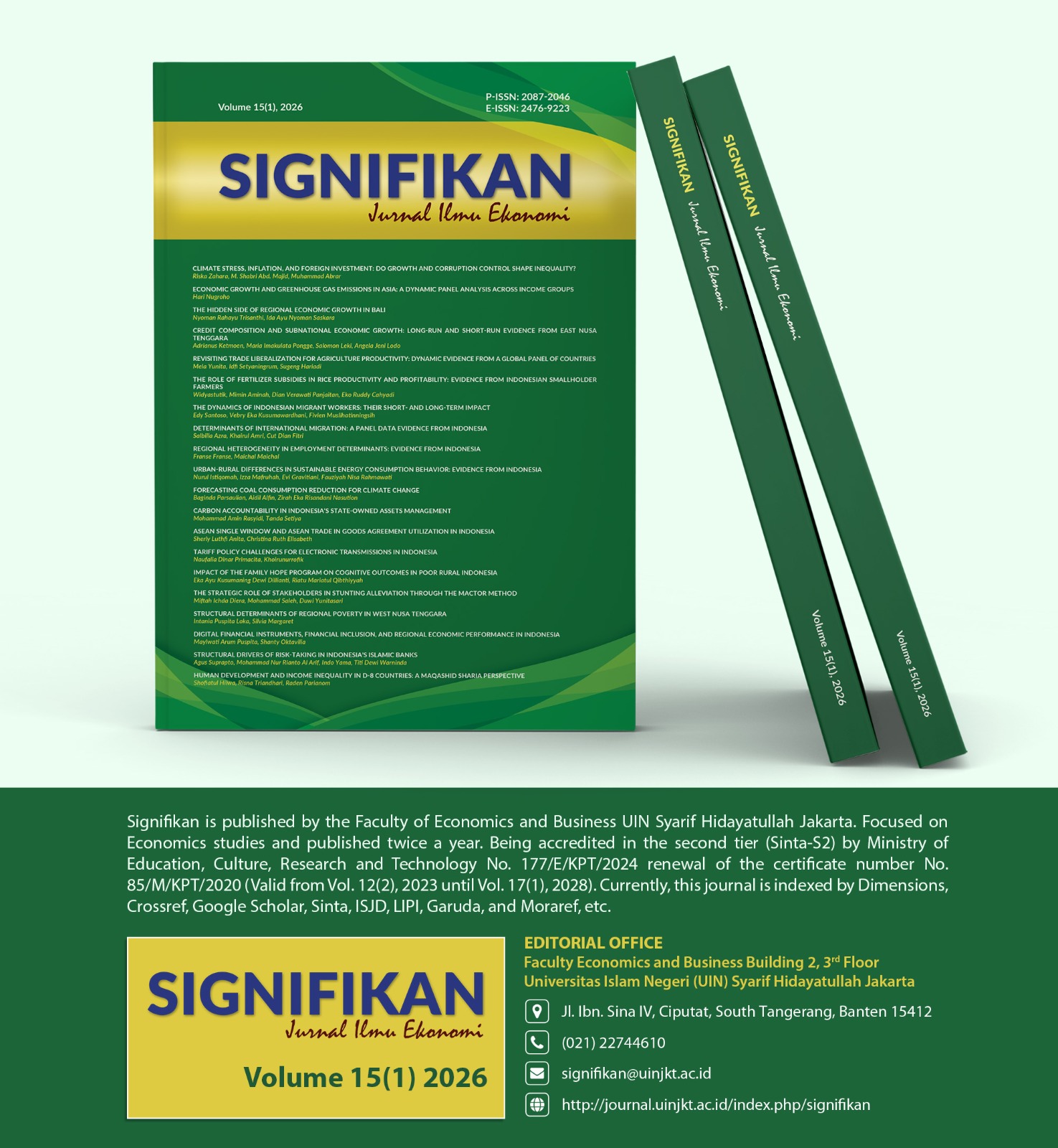
Credit Composition and Subnational Economic Growth: Long-Run and Short-Run Evidence from East Nusa Tenggara
DOI:
https://doi.org/10.15408/sjie.v15i1.50180Keywords:
financial intermediation, finance growth nexus, subnational growth dynamics, credit allocation structure, developing regional economyAbstract
Research Originality. This study advances the finance–growth nexus literature by providing subnational time-series evidence on credit composition rather than aggregate credit, focusing on a structurally developing province in Eastern Indonesia.
Research Objectives. This study examines whether different types of bank credit contribute differently to regional economic growth in East Nusa Tenggara.
Research Methods. This study applies the Autoregressive Distributed Lag (ARDL) approach. The ARDL Bounds Test is employed to verify cointegration, followed by Error Correction Model (ECM) estimation and diagnostic stability tests.
Empirical Results. The findings confirm a significant long-run relationship between credit composition and regional economic growth. Consumer credit exhibits a positive long-run effect on real GRDP, while investment credit shows a moderate impact. Working capital credit does not demonstrate a significant long-run contribution.
Implications. The results suggest that not only the volume but also the credit allocation structure plays a crucial role in shaping regional economic performance. Policy strategies in developing regions should therefore emphasize productive and demand-supporting credit allocation to promote sustainable growth.
JEL Classification: E44, O16, O47, R11
References
Aginta, H., & Someya, M. (2022). Regional Economic Structure and Heterogeneous Effects of Monetary Policy : Evidence from Indonesian Provinces. Journal of Economic Structures, 11(1), 1–25. https://doi.org/10.1186/s40008-021-00260-6.
Amaluddin, A., Indiastuti, R., Effendi, N., & Cupian, C. (2024). Rural ICT Penetration, Bank Credit, and Agricultural Sector Performance : A Panel ARDL Analysis in Eastern Indonesia. Agris On-Line Papers in Economics and Informatics, XVI(1), 3–14. https://doi.org/10.7160/aol.2024.160101.
Anama, Y. C., & Lubis, D. A. (2025). Is the Bank Credit able to Accelerate Economic Transformation ? A Multivariate Modeling of Key Sectors in Indonesia. Jurnal Ekonomi Indonesia, 14(2), 192–208. https://doi.org/10.52813/jei.v14i2.571.
Anton, Rahim, M., Armawaddin, M., Rostin, Syarif, M., & Barani, L. O. S. (2023). Pengaruh Investasi dan Kredit Perbankan terhadap Pertumbuhan Ekonomi di Indonesia. JPEP: Jurnal Progres Ekonomi Pembangunan, 8(2), 171–182.
Asllani, G., Luboteni, G., & Grima, S. (2020). Financial Integration, Banking Supervision and Sustainability of the Western Balkan Countries. International Journal of Economics and Business Administration, VIII(1), 3–14. https://doi.org/10.35808/ijeba/404.
Azolibe, C. B. (2020). Banking Sector Intermediation Development and Growth of a Developing Economy : An Empirical Investigation of Nigeria. Harvard University Press, 1–18. https://doi.org/10.21203/rs.3.rs-95127/v1.
Bellaa, F. I., Mawardia, I., & Amelia, I. (2022). Islamic Finance-Growth Nexus : Evidence from Indonesia. Shirkah: Journal of Economics and Business, 7(2), 139–154. https://doi.org/10.22515/shirkah.v7i2.472.
Budiman, A., Juhro, S. M., & Safuan, S. (2024). Capital Flow and Bank Lending Channels in a Small Open Economy : Evidence from Indonesia. Bulletin of Monetary Economics and Banking, 27(2), article 1. https://doi.org/10.59091/2460-9196.2190.
Çayır, B. (2021). The Impacts of International Capital Flows on Household Credits. Central Bank Review, 21(4), 131–140. https://doi.org/10.1016/j.cbrev.2021.12.001.
Firmansyah, M. (2024). Analysis of The Effect of Credit and Financial Technology on Economic Growth in ASEAN-5. JRIE: Jurnal Riset Ilmu Ekonomi, 4(2), 75–85.
Fukuda, T. (2025). India’s Finance -Growth Nexus with Carbon Emissions, Globalization, and Government Expenditure: A Non-Linear Approach Using ARDL and VARX Techniques. Journal of Economics, Finance and Management Studies, 8(5), 2572–2590.
Ho, S., & Saadaoui, J. (2022). Bank Credit and Economic Growth: A Dynamic Threshold Panel Model for ASEAN Countries. International Economics, 170, 1–26. https://doi.org/10.1016/j.inteco.2022.03.001.
Huda, S., Yuliati, A., & Setyawan, D. (2025). Revisiting Finance-Led Growth: Evidence From Disaggregated Bank Credit In Indonesia (Period 2009 – 2023). Journal of Economics and Business Letters, 5(5), 72-81. https://doi.org/10.55942/jebl.v5i5.755.
Idroes, G. M., Maulidar, P., Marsellindo, R., Afjal, M., & Hardi, I. (2024). The Impact of Credit Access on Economic Growth in SEA Countries. Indatu Journal of Management and Accounting, 2(2), 96–104. https://doi.org/10.60084/ijma.v2i2.256.
Kripfganz, S., & Schneider, D. C. (2023). ARDL: Estimating Autoregressive Distributed Lag and Equilibrium Correction Models. The Stata Journal, 23(4), 983–1019. https://doi.org/10.1177/1536867X231212434.
Lestari, R. M., Febriani, R. E., & Putri, N. T. (2021). Pengaruh Kredit Perbankan terhadap Pertumbuhan Ekonomi Provinsi di Sumatera. Convergence: The Journal Of Economic Development, 3(2), 179–195.
Lotto, J. (2023). Does Banking Sector Advancement Provide a Growth-Supporting Role to Tanzania's Economy? Economics and Business Quarterly Reviews, 6(3), 76–85. https://doi.org/10.31014/aior.1992.06.03.521.
Mamun, M. S. Al, & Ariffin, M. I. (2018). Does Domestic Credit of The Banking Sector Promote Economic Growth? Evidence from Bangladesh. International Journal of Islamic Business, 3(1), 33–55. https://doi.org/10.32890/ijib2018.3.1.3.
Mustofa, H. Z., & Faizin, M. (2025). The effect of Macroeconomic Factors on Economic Growth in Indonesia. JDE: Journal of Developing Economies, 10(1), 48–72. https://doi.org/10.20473/jde.v10i1.60620.
Naula, F., Zamora, C., & Gómez, K. (2025). The Influence of Bank Loans and Deposits on Ecuador’s Economic Growth: A Cointegration Analysis. International Journal of Studies, 13(76), 1–17. https://doi.org/10.3390/ijfs1302007.
Nkoro, E., & Uko, A. K. (2016). Autoregressive Distributed Lag (ARDL) Cointegration Technique: Application and Interpretation. Journal of Statistical and Econometric Methods, 5(4), 63–91.
Pesaran, M. H., Shin, Y., & Smith, R. J. (2001). Bounds Testing Approaches to the Analysis of Level Relationships. Journal of Applied Econometrics, 16(3), 289–362. https://doi.org/10.1002/jae.616.
Rahman, M. M., Vu, X.-B. (Benjamin)., & Nghiem, S. (2022). Economic Growth in Six ASEAN Countries : Are Energy, Human Capital, and Financial Development Playing Major Roles? Sustainability, 14(450), 4540. https://doi.org/10.3390/su14084540.
Razak, A. R., Soedarmono, W., Salasi, W., & Yudhi, A. (2020). Banking, Labor Force, and Regional Economic Growth: Evidence from Indonesia. Jurnal Keuangan Dan Perbankan, 24(2), 156–163.
Sinay, L. J., & Kembauw, E. (2023). The Influence of Macroeconomic Factors on Credit Risk of Banks in Indonesia using the ARDL Model. Pattimura International Journal of Mathematics (PIJMath), 2(02), 79–88. https://doi.org/10.30598/pijmathvol2iss2pp79-88
Sipahutar, M. A. (2024). The Journal of Academic Science Linkage of Money Growth on Banks Credit – Evidence from Indonesia. The Journal of Academic Science, 1(1), 27–36. https://doi.org/10.59613/m84y4381.
Sudrajad, O. Y., Wiryono, S. K., Kitri, M. L., & Rahadi, R. A. (2023). Does Financial Digitalization Affect Macroeconomic Stability in Indonesia? An Application of the Autoregressive Distributed Lag (ARDL) Model. IASE International Journal of Advanced and Applied Sciences, 10(10), 46–54. https://doi.org/10.21833/ijaas.2023.10.005.
Suhendra, I., & Ronaldo, E. (2017). Pengaruh Intermediasi Perbankan terhadap Pertumbuhan Ekonomi Indonesia. Tirtayasa Ekonomika, 12(1), 4443. https://doi.org/10.35448/jte.v12i1.4443.
Sumarni, L. (2019). Financial Development and Economic Growth in Indonesia: An ARDL-Bounds Testing Approach. EJEM Economic Journal of Emerging Markets, 11(1), 89–96. https://doi.org/10.20885/ejem.vol11.iss1.art9.
Tampubolon, J., Sihol, T., & Loh, A. (2021). The Nexus of Export, FDI, Financial Development, and Economic Growth in North Sumatra, Indonesia. Integrated Journal Of Business And Economics, 5(1), 10–24. https://doi.org/10.33019/ijbe.v4i3.328.
Uddin, I., Ahmad, M., Ismailov, D., Eid, M., Akhmedov, A., Khasanov, S., & Ul, M. (2023). Research in Globalization: Enhancing Institutional Equality to Boost Economic Development in Developing Nations: New Insights from the CS-ARDL Approach. Research in Globalization, 7, 100137. https://doi.org/10.1016/j.resglo.2023.100137.
Xiao, J., & Tao, C. (2020). Consumer Finance/Household Finance: The Definition and Scope. China Finance Review International, 11(1), 1–25. https://doi.org/10.1108/CFRI-04-2020-0032.
Downloads
Published
Issue
Section
License
Copyright (c) 2026 Adri Ketmoen, Maria Imakulata Pongge, Salomon Leki, Angela Jeni Lodo

This work is licensed under a Creative Commons Attribution-ShareAlike 4.0 International License.