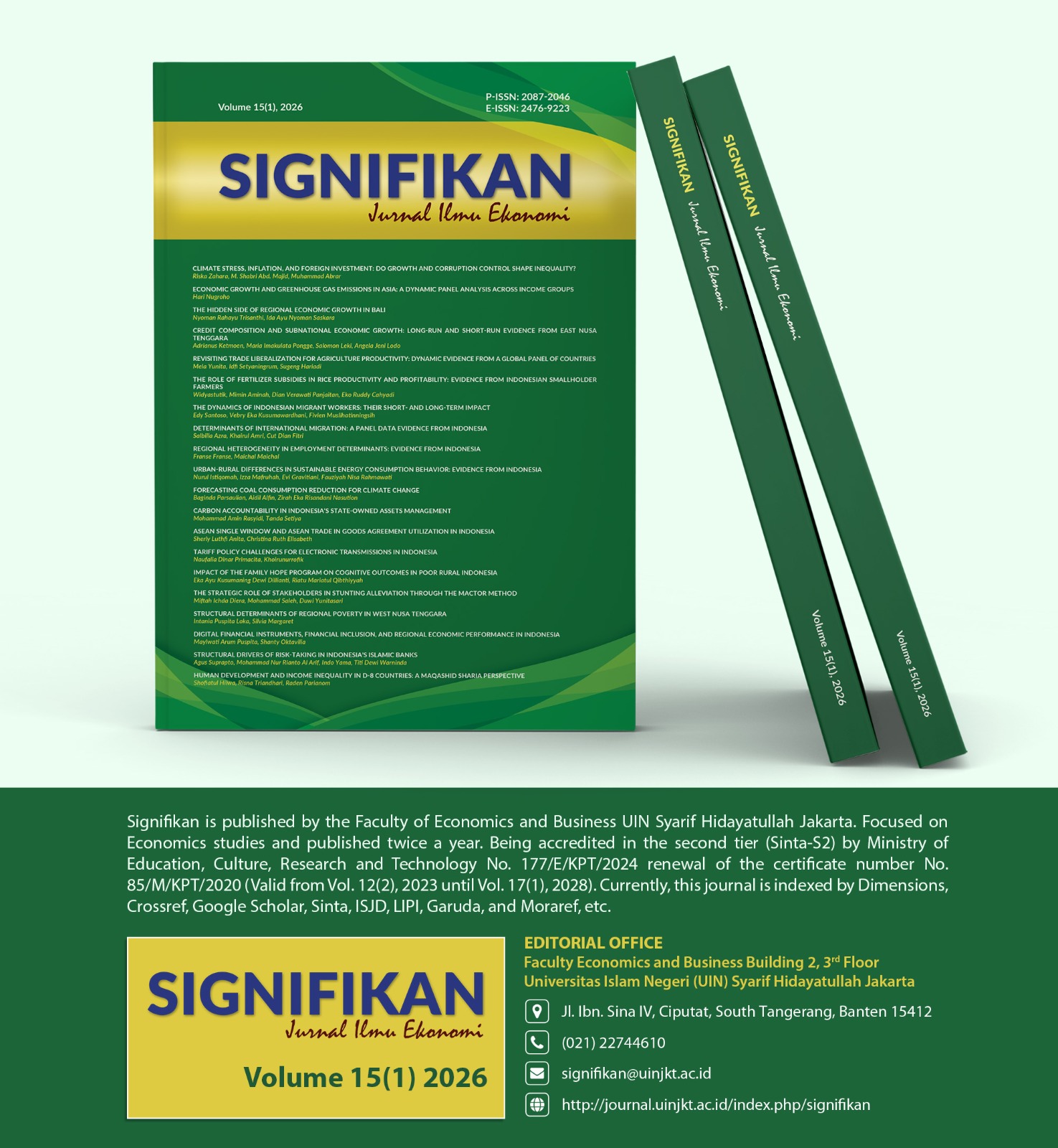
Revisiting Trade Liberalization for Agriculture Productivity: Dynamic Evidence from a Global Panel of Countries
DOI:
https://doi.org/10.15408/sjie.v15i1.49654Keywords:
heterogeneous trade effects, transmission channels, structural readiness, cross country analysisAbstract
Research Originality: This study contributes to the literature by providing a comparative analysis of the dynamic relationship between agricultural trade liberalisation and total factor productivity (TFP) growth across income groups. It highlights how differences in structural capacity and innovation systems shape heterogeneous productivity outcomes across countries.
Research Objectives: This study re-examines the dynamic impact of agricultural trade liberalisation on TFP growth across income groups and identifies the mechanisms underlying divergent productivity outcomes.
Research Methods: A panel Autoregressive Distributed Lag (ARDL) model is applied to panel data from 35 major agricultural-producing countries over the period 2007–2024 to capture heterogeneous short-run dynamics and common long-run relationships.
Empirical Results: The results reveal heterogeneous effects. Trade liberalisation significantly increases TFP growth in high-income countries through stronger technology diffusion and absorptive capacity. However, it generates weak or negative effects in middle-income countries due to structural constraints and limited innovation capacity.
Implications: Agricultural trade liberalisation does not automatically enhance productivity; its benefits depend on domestic structural readiness and innovation capacity.
JEL Classification: F13, Q17, O47, C23
References
Almeida, E. O., Cateia, J. V., Barbosa, W., & de Freitas, C. A. (2024). Trade Liberalization and Total Factor Productivity in Brazil: A VECM Modeling. PLoS ONE, 19(11), 0312599. https://doi.org/10.1371/journal.pone.0312599.
Anderson, K. (2022). Trade-Related Food Policies in A More Volatile Climate and Trade Environment. Food Policy, 109(3), 102253. https://doi.org/10.1016/j.foodpol.2022.102253.
Bai, Y., Jin, K., & Lu, D. (2024). Misallocation Under Trade Liberalization. American Economic Review, 114(7), 1949–1985. https://doi.org/10.1257/aer.20200596.
Barros, L., & Martínez-Zarzoso, I. (2022). Systematic Literature Review on Trade Liberalization and Sustainable Development. Sustainable Production and Consumption, 33(4), 921–931. https://doi.org/10.1016/j.spc.2022.08.012.
Bilgin, M. H. (2019). Trade Liberalization: Is It Desirable for All Developing Economies. Research in World Economy, 10(3), 199–204. https://doi.org/10.5430/RWE.V10N3P199.
Chiarella, C., Meyfroidt, P., Abeygunawardane, D., & Conforti, P. (2023). Balancing the Trade-offs between Land Productivity, Labor Productivity, and Labor Intensity. Ambio, 52(10), 1618–1634. https://doi.org/10.1007/s13280-023-01887-4.
Dai, M., Wang, G., Wang, J., Gao, Y., & Lu, Q. (2023). Study of the Spatial Spillover Effects of the Efficiency of Agricultural Product Circulation in Provinces Along The Belt and Road Under the Green Total Factor Productivity Framework. Sustainability, 15(16), 12560. https://doi.org/10.3390/su151612560.
Dinh, B. H., Phuc, H. N., Bui, T., & Nguyen, H. (2020). Declining Protection for Vietnamese Agriculture Under Trade Liberalization: Evidence from an Input-Output Analysis. Economies, 8(2), 43. https://doi.org/10.3390/economies8020043.
Farrokhi, F., & Pellegrina, H. S. (2023). Trade, Technology, and Agricultural Productivity. Journal of Political Economy, 131(9), 2509–2555. https://doi.org/10.1086/724319.
Fiankor, D., Haase, O. K., & Brümmer, B. (2021). The Heterogeneous Effects of Standards on Agricultural Trade Flows. Journal of Agricultural Economics, 72(1), 25–46. https://doi.org/10.1111/1477-9552.12405.
Fuglie, K. (2018). R & D Capital, R & D Spillovers, and Productivity Growth in World Agriculture. Applied Economic Perspectives and Policy, 40(3), 421–444. https://doi.org/10.1093/AEPP/PPX045.
Gollin, D. (2023). Agricultural Productivity and Structural Transformation: Evidence and Questions for African Development. Oxford Development Studies, 51(4), 375–396. https://doi.org/10.1080/13600818.2023.2280638.
Graf, H., & Mohamed, H. (2023). Beyond Trading: Knowledge Spillovers and Learning by Exportingin Global Value. Jena Economics Research Papers, 2023-008, Friedrich Schiller-University Jena.
Hartwell, C. (2022). Institutions and Trade-Related Inequality. International Journal of Finance and Economics, 27(3), 3246–3264. https://doi.org/10.1002/ijfe.2319.
Hung, N. T. (2021). Volatility Behaviour of the Foreign Exchange Rate and Transmission among Central and Eastern European Countries: Evidence from the EGARCH Model. Global Business Review, 22(1), 36–56. https://doi.org/10.1177/0972150918811713.
Jabuya, D. O., Sule, F. O., & Ndwiga, M. J. (2023). The Effect of Agricultural Trade Openness on Economic Growth in the East African Community. Cogent Economics and Finance, 11(2). https://doi.org/10.1080/23322039.2023.2250632
Liu, J., Wang, M., Yang, L., Rahman, S., & Sriboonchitta, S. (2020). Agricultural Productivity Growth and Its Determinants in South and Southeast Asian Countries. Sustainability, 12(12), 4981. https://doi.org/10.3390/su12124981.
Luo, H., & Qu, X. (2023). Export Trade, Absorptive Capacity, and High-Quality Economic Development in China. Systems, 11(2), 54. https://doi.org/10.3390/systems11020054.
Ma, Z., Wang, D., Feng, F., & Zhao, T. (2025). Moving Out of Agriculture: How Trade Liberalization Affects Agricultural Productivity in China. China Economic Review, 91, 102388. https://doi.org/10.1016/j.chieco.2025.102388.
Martínez-Zarzoso, I., & Chelala, S. (2021). Trade Agreements and International Technology Transfer. Review of World Economics, 157(3), 631–665. https://doi.org/10.1007/s10290-021-00420-7.
Pesaran, H. M., Shin, Y., & Smith, R. P. (1999). Pooled Mean Group Estimation of Dynamic Heterogeneous Panels. Journal of the American Statistical Association, 94(446), 621–634. https://doi.org/10.1080/01621459.1999.10474156.
Sandström, V., Huan-Niemi, E., Niemi, J., & Kummu, M. (2024). Dependency on Imported Agricultural Inputs: Global Trade Patterns and Recent Trends. Environmental Research: Food Systems, 1(1), 015002. https://doi.org/10.1088/2976-601x/ad325e.
Solow, R. M. (1957). Technical Change and the Aggregate Production Function. The Review of Economics and Statistics, 39(3), 312–320.
Sukoco, S., Hartono, D., & Patunru, A. (2020). The Impacts of Liberalization and Trade Facilitation on Economic Performance, Poverty, and Income Inequality: An Analytical Study. Economic Journal of Emerging Markets, 12(1), 67–79. https://doi.org/10.20885/ejem.vol12.iss1.art6.
Sunge, R., & Ngepah, N. (2022). Agricultural Trade Liberalisation, Agricultural Total Factor Productivity Growth and Food Security in Africa. Agrekon, 61(3), 292–313. https://doi.org/10.1080/03031853.2022.2066551.
Trakem, V., & Fan, H. (2024). Agricultural Trade Liberalization, Governance Quality, and Technical Efficiency in the Agricultural Sector of Southeast Asia. Heliyon, 10(21), e39553. https://doi.org/10.1016/j.heliyon.2024.e39553.
Wang, J., Wang, C., & Wan, X. (2021). Trade Liberalization, Energy Saving Technological Change and Energy Intensity: Some Empirical Evidence from China. Contemporary Economic Policy, 39(2), 365–376. https://doi.org/10.1111/coep.12514.
Xu, J., Wang, Y., Zhao, X., Etuah, S., & Liu, Z. (2023). Can Agricultural Trade Improve Total Factor Productivity? Empirical Evidence from G20 Countries. Frontiers in Sustainable Food Systems, 7, 1100038. https://doi.org/10.3389/fsufs.2023.1100038.
Zhou, Y., & Ji, Y. (2022). Trade Policy Uncertainty, Innovation and Total Factor Productivity. Sustainability, 14(1), 266. https://doi.org/10.3390/su14010266.
Downloads
Published
Issue
Section
License
Copyright (c) 2026 Mela Yunita, Setyaningrum Idfi, Sugeng Hariadi

This work is licensed under a Creative Commons Attribution-ShareAlike 4.0 International License.