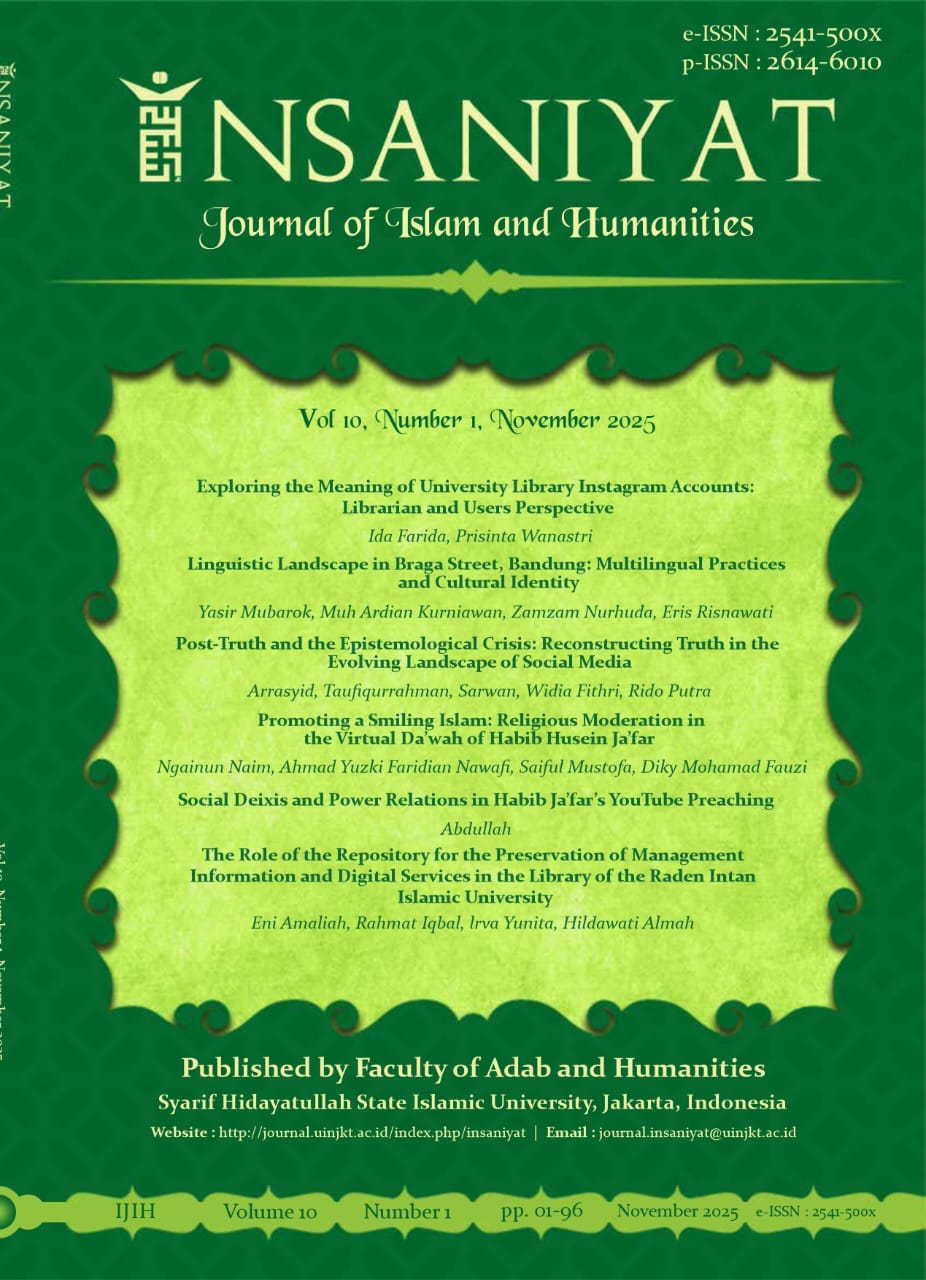
Post-Truth and the Epistemological Crisis: Reconstructing Truth in the Evolving Landscape of Social Media
DOI:
https://doi.org/10.15408/insaniyat.v10i1.46524Keywords:
Post-truth, Epistemology, Media, Ideological PolarizationAbstract
The rapid expansion of digital media and the surge of misinformation have created a profound epistemological crisis that challenges established notions of truth and knowledge. This study analyzes the reconstruction of truth in the post-truth era, in which emotional narratives and ideological biases frequently outweigh empirical evidence. Employing a descriptive-analytical method, the research explores the implications of post-truth dynamics for epistemic authority, public trust, and digital literacy. Primary and secondary sources including academic literature, books, and peer-reviewed articles on epistemology and digital media are examined to provide a comprehensive theoretical framework. The findings indicate that misinformation is often fueled by emotional persuasion, algorithmic personalization intensifies ideological polarization, and diminishing institutional credibility accelerates epistemic relativism. These conditions collectively weaken society’s capacity to distinguish reliable information from falsehoods. The study concludes that reconstructing truth in the digital age requires a multidimensional strategy that integrates robust digital literacy, transparent media practices, and strengthened epistemic responsibility. Such an approach is essential to restoring informed judgment, rebuilding trust, and safeguarding the integrity of knowledge in contemporary public discourse.
References
Bail, C. A., & et al. (2018). Exposure to Opposing Views on Social Media Can Increase Political Polarization. Proceedings of the National Academy of Sciences, 115(37), 9216–9221.
Bakir, V., & McStay, A. (2018). Fake News and the Economy of Emotions. Digital Journalism, 6(2), 154–175.
Bakshy, E., Messing, S., & Adamic, L. A. (2015). Exposure to Ideologically Diverse News and Opinion on Facebook. Science, 348, 1130–1132.
Basol, M., Roozenbeek, J., & Van der Linden, S. (2021). Good News about Bad News: Gamified Inoculation Boosts Confidence and Cognitive Immunity Against Fake News. Harvard Kennedy School Misinformation Review, 2(1).
Benkler, Y., Faris, R., & Roberts, H. (2018). Network Propaganda: Manipulation, Disinformation, and Radicalization in American Politics. New York: Oxford University Press.
Bennett, W. L., & Livingston, S. (2018). The Disinformation Order: Disruptive Communication and the Decline of Democratic Institutions. European Journal of Communication, 33(2), 122–139.
Binns, R. (2018). Fairness in Machine Learning: Lessons from Political Philosophy. Proceedings of the 2018 Conference on Fairness, Accountability, and Transparency, 149–159.
Bradley, F. H. (1914). Essays on Truth and Reality. New York: Oxford University Press.
Chesney, R., & Citron, D. (2019). Deep Fakes: A Looming Challenge for Privacy, Democracy, and National Security. California Law Review, 107(6), 1753–1819.
Cinelli, M., & et al. (2020). The COVID-19 Social Media Infodemic. Scientific Reports, 10(1).
D’Ancona, M. (2017). Post-Truth: The New War on Truth and How to Fight Back. London: Ebury Press.
Dewey, J. (1938). Logic: The Theory of Inquiry. New York: Holt, Rinehart & Winston.
Flaxman, S., Goel, S., & Rao, J. M. (2016). Filter Bubbles, Echo Chambers, and Online News Consumption. Public Opinion Quarterly, 80(1), 298–320.
Floridi, L. (2019). The Logic of Information. New York: Oxford University Press.
Fukuyama. (2018). Identity: The Demand for Dignity and the Politics of Resentment. New York: Farrar, Straus and Giroux.
Fuller, S. (2019). Post-Truth: Knowledge as a Power Game. London: Anthem Press.
Graves, L. (2018). Boundaries Not Drawn: Mapping the Institutional Roots of the Global Fact-Checking Movement. Journalism Studies, 19(5), 613–631.
Guess, A., Nyhan, B., & Reifler, J. (2018). Selective Exposure to Misinformation: Evidence from the Consumption of Fake News During the 2016 US Presidential Campaign. European Research Council.
Helberger, N. (2019). Challenging Algorithmic Profiling: The Limits of Data Protection and Anti-Discrimination in Responding to Algorithmic Bias. Big Data & Society, 6(2).
James, W. (1907). Pragmatism: A New Name for Some Old Ways of Thinking. London: Longmans, Green, & Co.
Journal of Media Literacy Education. (2023). Cognitive Processing of Online News: The Role of Confirmation Bias and Misinformation. JMLE, 15(2), 31–43.
Keyes, R. (2004). The Post-Truth Era: Dishonesty and Deception in Contemporary Life. New York: St. Martin’s Press.
Larson, H. J., & et al. (2018). The State of Vaccine Confidence 2018: Global Insights Through A 67-Country Survey. EClinicalMedicine, 2, 17–23.
Lewandowsky, S., Ecker, U. K., & Cook, J. (2017). Beyond Misinformation: Understanding and Coping with the “Post-Truth” Era. Journal of Applied Research in Memory and Cognition, 6(4), 353–369.
Lyotard, J. F. (1984). The Postmodern Condition: A Report on Knowledge. Minneapolis, Minnesota: University of Minnesota Press.
McIntyre, L. (2018). Post-Truth. Cambridge, Massachusetts: MIT Press.
Mittelstadt, B. D., & et al. (2016). The Ethics of Algorithms: Mapping the Debate. Big Data & Society, 3(2).
Nichols, T. (2017). The Death of Expertise: The Campaign Against Established Knowledge and Why It Matters. New York: Oxford University Press.
Nickerson, R. S. (1998). Confirmation Bias: A Ubiquitous Phenomenon in Many Guises. Review of General Psychology, 2(2), 175–220.
Oreskes, N., & Conway, E. M. (2010). Merchants of Doubt: How a Handful of Scientists Obscured the Truth on Issues from Tobacco Smoke to Global Warming. London: Bloomsbury Press.
Oxford University Press. (2025). Word of the Year 2016.
Pariser, E. (2011). The Filter Bubble: What the Internet is Hiding from You. City of Westminster, London: Penguin Books.
Pennycook, G., & Rand, D. G. (2019). Fighting Misinformation on Social Media Using “Nudges”: The Effects of Accuracy Prompts on Sharing Behaviour. Nature Communications, 10, 1–9.
Ribeiro, M. H., & et al. (2020). Auditing Radicalization Pathways on YouTube. Proceedings of the ACM on Human-Computer Interaction, 4((CSCW)), 1–27.
Rini, R. (2017). Fake News and Partisan Epistemology. Kennedy Institute of Ethics Journal, 27(2), 43–64.
Stanley, J. (2015). How Propaganda Works. Princeton, New Jersey: Princeton University Press.
Sunstein, C. R. (2017). #Republic: Divided Democracy in the Age of Social Media. Princeton, New Jersey: Princeton University Press.
Tarski, A. (1944). The Semantic Conception of Truth and the Foundations of Semantics. Philosophy and Phenomenological Research, 4(3), 341–376.
Vosoughi, S., Roy, D., & Aral, S. (2018). The Spread of True and False News Online. Science, 359(6380), 1146–1151.
Wardle, C., & Derakhshan, H. (2017). Information Disorder: Toward an Interdisciplinary Framework for Research and Policymaking.
Nickerson, R. S. (1998). Confirmation Bias: A Ubiquitous Phenomenon in Many Guises. Review of General Psychology, 2(2), 175–220.
Mudjiyanto, B., & Dunan, A. (2019). Literasi Media di Era Post-Truth. PROMEDIA: Public Relation dan Media Komunikasi, 5(1), 27–40.
Nurfazri, M., Irwansyah, F. S., Lukman, F., Ruhullah, M. E., & Marinda, S. M. (2024). Digital Literacy in Education: An Analysis of Critical Thinking Culture for Preventing Hoaxes. Jurnal Perspektif, 8(1), 1–22.
Qiu, C. (2024). The Impact of Media Literacy and Internet Information Trustworthiness on Fact-Checking Behavior Among Elderly Internet Users. International Journal of Social Sciences and Public Administration, 3(3), 45–61.
Downloads
Published
Issue
Section
License
Copyright (c) 2025 Arrasyid, Taufiqurrahman, Sarwan, Widia Fithri, Rido Putra

This work is licensed under a Creative Commons Attribution-ShareAlike 4.0 International License.