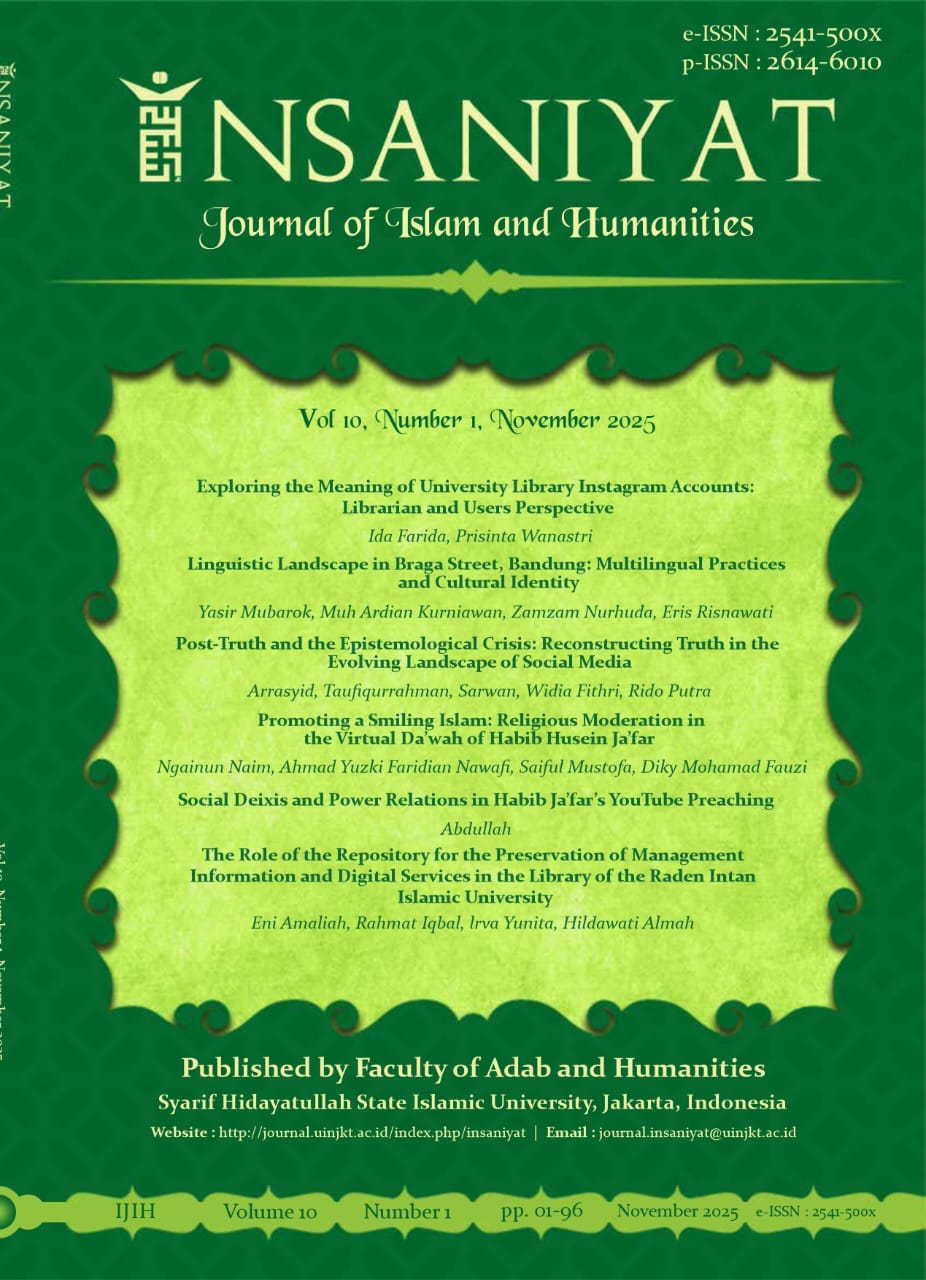
Linguistic Landscape in Braga Street, Bandung: Multilingual Practices and Cultural Identity
DOI:
https://doi.org/10.15408/insaniyat.v10i1.46439Keywords:
Linguistic Landscape, Multilingualism, Cultural Identity, Heritage Street, BandungAbstract
This study investigates the linguistic landscape of Jalan Braga, Bandung, a heritage street rich in historical and cultural significance. Using a qualitative descriptive design, data were collected through photographic documentation, field observation, and secondary sources, resulting in 60 signage items analyzed. Findings reveal that monolingual signage dominates (68.3%), particularly in English and Indonesian, followed by bilingual (23.3%) and multilingual signs (8.4%). The results demonstrate that English functions both as a global lingua franca and a branding tool, while Indonesian serves as a marker of national identity. Dutch signage symbolizes colonial heritage, whereas Sundanese, though limited in number, reflects local cultural identity. Multilingual signs, though fewer, strategically integrate languages such as Japanese, Korean, and Mandarin to project cosmopolitanism and cultural hybridity. The study highlights how language use in Braga reflects not only practical communication but also symbolic functions tied to identity, history, and globalization. This research contributes to linguistic landscape studies by emphasizing the interplay of colonial, national, local, and global languages in urban heritage spaces.
References
Al Farisi, R. (2025, January 14). Kunjungan wisatawan di Bandung selama 2024 [Tourist visits to Bandung during 2024]. Antarafoto. https://www.antarafoto.com/id/view/2421890/kunjungan-wisatawan-di-bandung-selama-2024
Alhamidi, R. (2024, January 20). 7,7 wisatawan kunjungi Kota Bandung sepanjang 2023 [7.7 million tourists visited Bandung City throughout 2023]. DetikJabar. https://www.detik.com/jabar/berita/d-7151129/7-7-wisatawan-kunjungi-kota-bandung-sepanjang-2023
Artawa, K., Paramarta, I. M. S., Mulyanah, A., & Atmawati, D. (2023). Centripetal and centrifugal interconnection on hotel and restaurant linguistic landscape of Bali, Indonesia. Cogent Arts & Humanities, 10(1), 2218189. https://doi.org/10.1080/23311983.2023.2218189
Atmawati, D., Mulyanah, A., Endardi, J., Muhardis, M., & Fatinah, S. (2024). The role of language in economic activities in the Borobudur area: a linguistic landscape study. Cogent Arts & Humanities, 11(1), 2365042. https://doi.org/10.1080/23311983.2024.2365042
Backhaus, P. (2010). Multilingualism in Japanese public space–Reading the signs. Japanese Studies, 30(3), 359–372. https://doi.org/10.1080/10371397.2010.518598
Bagaskara, B. (2025, June 2). Kisah Braga Bandung: Pedati, jalan culik, hingga bangunan ikonik [The story of Braga Bandung: Pedati, kidnap streets, and iconic buildings]. DetikJabar. https://www.detik.com/jabar/berita/d-7942730/kisah-braga-bandung-pedati-jalan-culik-hingga-bangunan-ikonik
Brighton. (2025, May 22). Jalan Braga Bandung: Pesona abadi “Paris van Java” dan magnet properti bernilai sejarah di jantung kota kembang [Braga Street, Bandung: The timeless charm of the “Paris of Java” and a magnet for historical properties in the heart of the flower city]. Brighton.Co.Id. https://www.brighton.co.id/about/articles-all/jalan-braga-bandung-properti-sejarah-paris-van-java-heritage
Bruyèl-Olmedo, A., & Juan-Garau, M. (2015). Shaping tourist LL: language display and the sociolinguistic background of an international multilingual readership. International Journal of Multilingualism, 12(1), 51–67. https://doi.org/10.1080/14790718.2013.827688
Chernyavskaya, V. E. (2023). Typography as social index: Soviet landscape in the modern Russian discourse. ΠΡΑΞΗMΑ. Journal of Visual Semiotics, 2(36), 50–73. https://doi.org/10.23951/2312-7899-2023-2-50-73
Coelho, D., Ramos, D., & Sousa, B. B. (2024). The importance of foreign language mastery in the tourism sector (pp. 59–69). In Tourism and language studies. https://doi.org/10.1515/ijsl-2020-0043
Coelho, D., Ramos, D., & Sousa, B. B. (2024). The importance of foreign language mastery in the tourism sector. In A. Abreu, J. V.
Carvalho, P. Liberato, & H. C. Monroy (Eds.), Advances in tourism, technology and systems (pp. 59–69). https://doi.org/10.1007/978-981-99-9765-7_6
Dai, J., Chen, H., & Zhang, Z. (2024). How does a historical linguistic landscape influence tourists’ behavioral intention? A mixed-method study. Tourism Management Perspectives, 53, 101294. https://doi.org/10.1016/j.tmp.2024.101294
Daraškienė, I. (2024). Functions of English language in the linguistic landscape of Vilnius. Taikomoji Kalbotyra, 21, 144–157. https://doi.org/10.15388/Taikalbot.2024.21.9
Jiang, J., & Lui, H.-K. (2023). Pursuing dreams in an Asian global city: Does host language proficiency matter for Asian minorities? Urban Studies, 60(2), 360–378. https://doi.org/10.1177/00420980221092873
Landry, R., & Bourhis, R. Y. (1997). Linguistic landscape and ethnolinguistic vitality. Journal of Language and Social Psychology, 16(1), 23–49. https://doi.org/10.1177/0261927X970161002
Lee, K., & Lee, N. (2025). A geosemiotic analysis of the linguistic landscape in a touristified residential neighborhood. Journal of Tourism and Cultural Change, 23(2–3), 247–266. https://doi.org/10.1080/14766825.2025.2512349
Lu, S., Li, G., & Xu, M. (2020). The linguistic landscape in rural destinations: A case study of Hongcun Village in China. Tourism Management, 77, 104005. https://doi.org/10.1016/j.tourman.2019.104005
Mambetaliev, A. (2025). Linguistic landscapes of peripheral small towns: a case study of Villány, Hungary. International Journal of Multilingualism, 1–10. https://doi.org/10.1080/14790718.2025.2517333
Mubarok, Y., Sudana, D., Nurhuda, Z., & Yanti, D. (2024 Linguistic landscape in the tourist area, Lembang Bandung, Indonesia. World Journal of English Language, 14(2), 230. https://doi.org/10.5430/wjel.v14n2p230
Mustapić, E. (2019). From šećerna tabla to čoCROlada: A study of multilingual discourse on Croatian food labels. Jezikoslovlje, 20(1), 119–146. https://doi.org/10.29162/jez.2019.5
Napu, N. (2024). Linguistic landscapes in multilingual urban settings: Insights from translation perspectives. Studies in English Language and Education, 11(1), 530–548. https://doi.org/10.24815/siele.v11i1.29559
Nenotek, S. A., Paramarta, I. M. S., Sjioen, A. E., Beeh, N., Cornelis, A. R., & Benu, N. N. (2025). The linguistic landscape for sustainable and inclusive tourism: insight from Timor Tengah Selatan, Indonesia. Cogent Arts & Humanities, 12(1), 2441579. https://doi.org/10.1080/23311983.2024.2441579
Pandarangga, S. (2016). The transformation of English as a global language in the world. LiNGUA: Jurnal Ilmu Bahasa Dan Sastra, 10(2), 90–96. https://doi.org/10.18860/ling.v10i2.3132
Pathanasin, S. (2025). A Study of the Linguistic Landscape on Phuket Island: Identity, Tourism and Policy. REFLections, 32(1), 213–233. https://doi.org/10.61508/refl.v32i1.279617
Pooc. (2022, March 27). Arti Ceu / Euceu dalam bahasa gaul dan asal katanya [The meaning of Ceu / Euceu in slang and its origin]. Pooc.org. https://www.pooc.org/arti-ceu/
Rohmadi, M., Sudaryanto, M., Andris Susanto, D., Saddhono, K., & Saputra, A. D. (2023). Sociopragmatic Study of Javanese Oral Discourse in Big City Communities as an Effort to Maintain Indigenous Language. Research Journal in Advanced Humanities, 4(4). https://doi.org/10.58256/rjah.v4i4.1290
Rohmah, Z., & Wijayanti, E. W. N. (2023). Linguistic landscape of Mojosari: Language policy, language vitality and commodification of language. Cogent Arts & Humanities, 10(2), 2275359. https://doi.org/10.1080/23311983.2023.2275359
Sakhiyya, Z., & Martin-Anatias, N. (2020). Reviving the language at risk: a social semiotic analysis of the linguistic landscape of three cities in Indonesia. International Journal of Multilingualism, 20(2), 290–307. https://doi.org/10.1080/14790718.2020.1850737
Seddon, R. (2024). Wistful Objects. In The Routledge Handbook of Nostalgia (pp. 455–466). Routledge. https://doi.org/10.4324/9781003364924-41
Silverstein, M. (2003). Indexical order and the dialectics of sociolinguistic life. Language & Communication, 23(3–4), 193–229. https://doi.org/10.1016/S0271-5309(03)00013-2
Silviyanti, T. M., Yusuf, Y. Q., & Akmal, S. (2024). From words to wealth: Decoding the language markers and compositions of shop names in Banda Aceh. Humanities, Arts and Social Sciences Studies. https://doi.org/10.69598/hasss.24.3.267548
Sudarmanto, B. A., Benu, N. N., Wahyuni, T., Aji, E. N. W., Kurnia, N., Mulyanah, A., Purba, A., Djuwarijah, S., Istiana, I. I., & Utami, R. E. (2025). Language preservation through public signage: Analyzing the linguistic landscape of the Indonesia–Timor Leste border. Forum for Linguistic Studies, 7(4), 601–612. https://doi.org/10.30564/fls.v7i4.9052
Trianto, I., Muniroh, R. D. D., Gunawan, W., Isnendes, R., & Wirza, Y. (2025). Language attitude of millennial Sundanese speakers: A sociolinguistic perspective. JURNAL ARBITRER, 12(2), 192–209. https://doi.org/10.25077/ar.12.2.192-209.2025
Vandenbroucke, M. (2016). Socio‐economic stratification of English in globalized landscapes: A market‐oriented perspective. Journal of Sociolinguistics, 20(1), 86–108. https://doi.org/10.1111/josl.12166
Wang, X., & Gao, Y. (2025). The role of English in the linguistic landscape of Luang Prabang. English Today, 1–11. https://doi.org/10.1017/S0266078424000476
Wardzyńska, A. (2024). Ludzie, język i przestrzeń – co mówi nam krajobraz multilingwistyczny Kuala Lumpur o mniejszości chińskiej w Malezji [People, Language, and Space – What Does the Multilingual Landscape of Kuala Lumpur Tell Us About the Chinese Minority in Malaysia?]. Prace i Studia Geograficzne, 69(3), 85–100. https://doi.org/10.48128/pisg-2024-69.3-05
Yuan, M. (2019). Submission and resistance in the English linguistic landscape of Chaoshan. English Today, 35(2), 20–28. https://doi.org/10.1017/S0266078418000214
Zulkhairil, A. (2024, January 20). 2023: Kunjungan wisatawan Kota Bandung capai 7,7 juta orang [Tourist visits to Bandung City reached 7.7 million people]. IDN Times Jabar. https://jabar.idntimes.com/news/jawa-barat/2023-kunjungan-wisatawan-kota-bandung-capai-7-7-juta-orang-00-nqtvm-6f7w63
Downloads
Published
Issue
Section
License
Copyright (c) 2025 Eris Risnawati, Muh Ardian Kurniawan, Zamzam Nurhuda, Yasir Mubarok

This work is licensed under a Creative Commons Attribution-ShareAlike 4.0 International License.