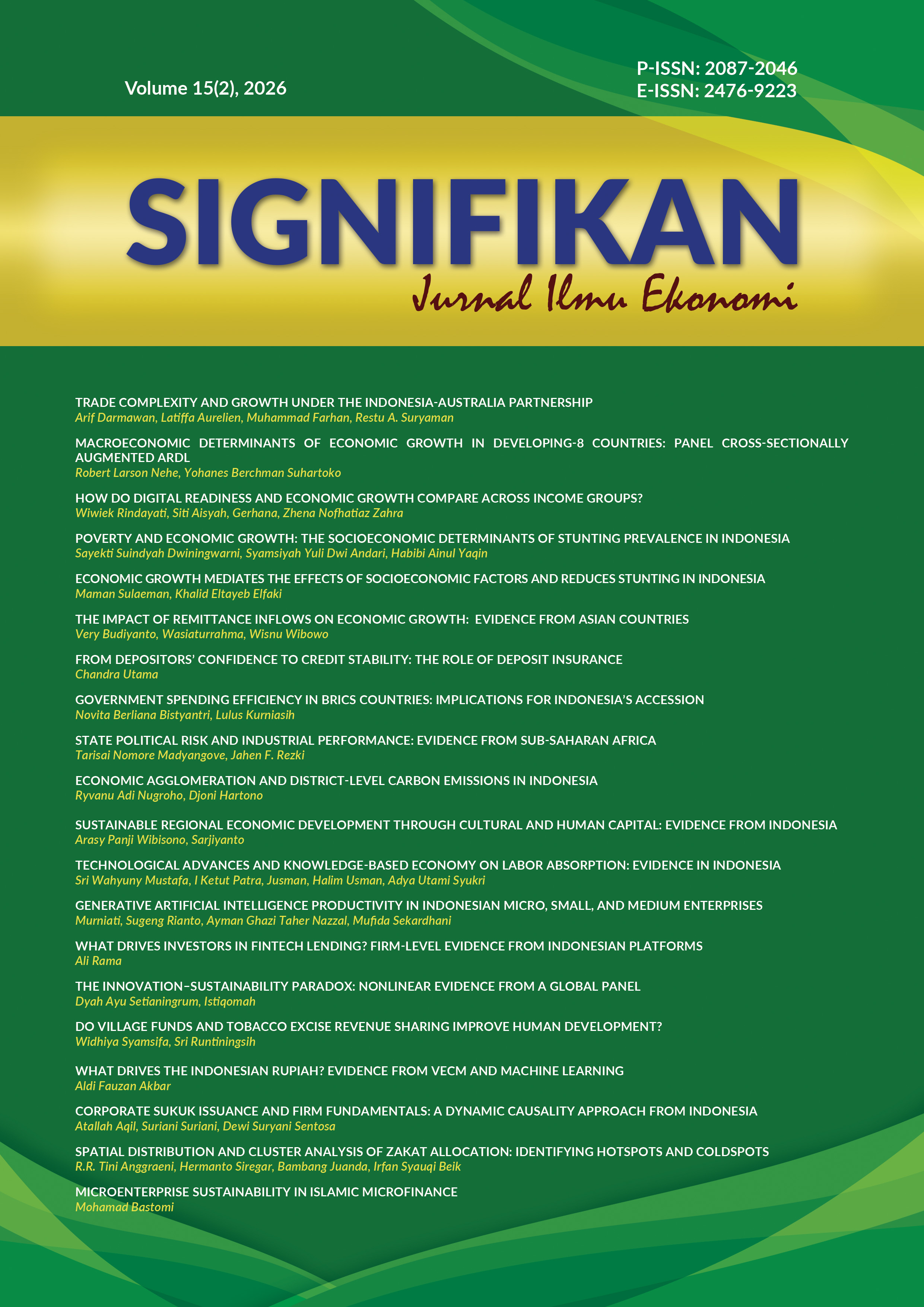
Trade Complexity and Growth under the Indonesia-Australia Partnership
DOI:
https://doi.org/10.15408/sjie.v15i2.51348Keywords:
bilateral partnership, economic complexity, export sophistication, error correction model, trade liberalizationAbstract
Research Originality: This study contributes by linking Indonesia-Australia bilateral trade, economic complexity, and wholesale price dynamics within a single error-correction framework following the partnership's entry into force.
Research Objectives: The study investigates the impact of exports, imports, economic complexity, merchandise trade openness, and wholesale prices on Indonesia's growth in both the short and long term from 2010 to 2025.
Research Methods: Annual data are analyzed using Augmented Dickey-Fuller tests, Engle-Granger cointegration tests, and an error correction model, supported by residual diagnostics, for five bilateral trade variables.
Empirical Results: The results indicate that all variables are associated with long-term development, while wholesale prices, imports, and exports primarily drive short-term fluctuations. Economic complexity is more significant as a structural channel than as an annual upheaval.
Implications: These results suggest that Indonesia should focus on trade liberalization under the IA-CEPA, as it could serve as a real growth engine. Policy should move beyond trade volume targets by enhancing export diversification, stabilizing wholesale price transmission, and leveraging the partnership to strengthen skills, technology transfer, and higher-value-added production.
JEL Classification: F13, F41, F62
How to Cite:
Darmawan, A., Aurelien, L., Farhan, M., & Suryaman, R. A. (2026). Trade Complexity and Growth under the Indonesian-Australia Partnership. Signifikan: Jurnal Ilmu Ekonomi, 15(2), 327-338. https://doi.org/10.15408/sjie.v15i2.51348.
References
Akbar, R. R. F., Sari, D. S., & Rezasyah, T. (2025). Inclusiveness of Actors in the Sustainable Development Goals (SDGs) Agenda: The Role of the Provincial Government through the Global Governance Review. Intermestic: Journal of International Studies, 10(1), 238–262. https://doi.org/10.24198/intermestic.v10n1.6.
Anggresta, V., Subiyantoro, H., & Astuty, P. (2024). Foreign Debt: Causes and Theirs Impact on Economic Growth in Indonesia. Signifikan: Jurnal Ilmu Ekonomi, 13(2), 303–310. https://doi.org/10.15408/sjie.v13i2.40681.
Bhattacharyay, B. N., & Mukhopadhyay, K. (2015). A Comprehensive Economic Partnership Between India and Japan: Impact, Prospects, and Challenges. Journal of Asian Economics, 39, 94–107. https://doi.org/10.1016/j.asieco.2015.06.006.
Calì, M., Graciano, S. C., Ghose, D., Montfaucon, A. F., & Ruta, M. (2026). Trade Policy and Exporters’ Resilience: Evidence from Indonesia. Journal of Development Economics, 179, 103561. https://doi.org/10.1016/j.jdeveco.2025.103561.
Engle, R. F., & Granger, C. W. J. (1987). Co-Integration and Error Correction: Representation, Estimation, and Testing. Econometrica, 55(2), 251–276. JSTOR. https://doi.org/10.2307/1913236
Furtana, T. E. (2025). Navigating New Economic Frontiers: China-led Trade Agreements, US-China Trade Wars, and the Impact of Trump-Era Tariff Policies. Journal of Emerging Economies and Policy, 10(2), 129–137.
Gray, N., Laukkala, J., & Findlay, C. (2022). Implementation of Cooperation Chapters in Trade Agreements. Journal of Southeast Asian Economies, 39(2), 211–220. JSTOR.
Gürel, S. P., & Ergül, B. (2026). The J-Curve Hypothesis in Türkiye’s Bilateral Trade: Does Technology Intensity Matter? Alanya Akademik Bakış, 10(2), 587–599. https://doi.org/10.29023/alanyaakademik.1885823
Han, H., Liu, T., & Lu, D. (2026). The announcement effect on international currency choices: Theory and evidence. Journal of International Money and Finance, 160, 103450. https://doi.org/10.1016/j.jimonfin.2025.103450.
Hansa, R. A. (2024). Manfaat dan Peluang Perjanjian Ia-Cepa (Indonesia-Australia Comprehensive Economic Partnership Agreement) dan Dampaknya terhadap Impor Indonesia-Australia. Jurnal Ilmiah Wahana Pendidikan, 10(22), 1114–1128.
Hidalgo, C. A., & Hausmann, R. (2009). The Building Blocks of Economic Complexity. Proceedings of the National Academy of Sciences, 106(26), 10570–10575. https://doi.org/10.1073/pnas.0900943106.
Kim, M.-J. (2026). Bilateral Trade and Exchange Rate Volatility: Evidence from a Multiple-Threshold Nonlinear ARDL Model. Economies, 14(2), 67. https://doi.org/10.3390/economies14020067.
Linders, G.-J., Slangen, A., De Groot, H. L. F., & Beugelsdijk, S. (2005). Cultural and Institutional Determinants of Bilateral Trade Flows. SSRN Electronic Journal. https://doi.org/10.2139/ssrn.775504.
Muthahharah, I., Meliyana, S. M., & Mar’ah, Z. (2025). Forecasting Indonesia’s Wholesale Price Index (WPI) Using the Holt’s Exponential Smoothing Method. Quantitative Economics and Management Studies, 6(2), 302-308.
Narayan, P. K. (2005). The Saving and Investment Nexus for China: Evidence from Cointegration Tests. Applied Economics, 37(17), 1979–1990. https://doi.org/10.1080/00036840500278103.
Narayan, P. K., Rath, B. N., & Syarifuddin, F. (2022). Understanding the Role of Trade Agreements in Indonesia’s FDI. Journal of Asian Economics, 82, 101532. https://doi.org/10.1016/j.asieco.2022.101532.
Noureen, S., & Mahmood, Z. (2022). The effects of trade cost components and uncertainty of time delay on bilateral export growth. Heliyon, 8(1), e08779. https://doi.org/10.1016/j.heliyon.2022.e08779
Park, S. (2025). A Disrupted Global Trading System and the Future of Multilateralism. Asia and the Global Economy, 5(2), 100123. https://doi.org/10.1016/j.aglobe.2025.100123.
Pastpipatkul, P., Boonyakunakorn, P., & Phetsakda, K. (2020). The Impact of Thailand’s Openness on Bilateral Trade between Thailand and Japan: Copula-Based Markov Switching Seemingly Unrelated Regression Model. Economies, 8(1), 9. https://doi.org/10.3390/economies8010009.
Rahim, A., & Sudirman, A. (2023). South Korea’s New Southern Policy: Viewing Indonesia as a Strategic Partner through IK-CEPA. Indonesian Governance Journal, 6(1), 1–15. https://doi.org/10.24905/igj.6.1.2023.1-15.
Rahman, A., Murad, S. M. W., & Wang, X. (2024). Exchange Rate Asymmetry and Its Impact on Bilateral Trade: Evidence from BCIM-EC Countries using N-ARDL Approach. Heliyon, 10(1), e23886. https://doi.org/10.1016/j.heliyon.2023.e23886.
Shaommy, M., & Paksi, A. K. (2024). The Influence of The Indonesia-Australia Comprehensive Economic Partnership Agreement (IA-CEPA) on Australian Green Economy Investments Expansion in Indonesia. SHS Web of Conferences, 204, 02001. https://doi.org/10.1051/shsconf/202420402001.
Shrestha, M. B., & Bhatta, G. R. (2018). Selecting Appropriate Methodological Framework for Time Series Data Analysis. The Journal of Finance and Data Science, 4(2), 71–89. https://doi.org/10.1016/j.jfds.2017.11.001.
Toledo, H. (2017). The IA-CEPA and Sector Adjustments: A Specific-Factors Model of Production. International Review of Economics & Finance, 48, 201–211. https://doi.org/10.1016/j.iref.2016.11.006.
Verma, T. (2026). An Analysis of Economic Impact of the UAE–India CEPA on Bilateral Trade: A Data Driven Study Over the Years. International Journal for Research Publication and Seminar, 17(1), 22–33. https://doi.org/10.36676/jrps.v17.i1.350.
Wibisono, G. R. (2025). Leveraging the IA-CEPA Framework: Achieving Australia and Indonesia’s Interests in the Electric Vehicle Sector Through Fundings and Educational Platform. Journal of World Trade Studies, 10(1), 17–33. https://doi.org/10.22146/jwts.v10i1.22570.
Wong, J., & Chan, S. (2003). China-Asean Free Trade Agreement: Shaping Future Economic Relations. Asian Survey, 43(3), 507–526. https://doi.org/10.1525/as.2003.43.3.507.
Downloads
Published
Issue
Section
License
Copyright (c) 2026 Arif Darmawan, Latiffa Aurelien, Muhammad Farhan, Restu A. Suryaman

This work is licensed under a Creative Commons Attribution-ShareAlike 4.0 International License.