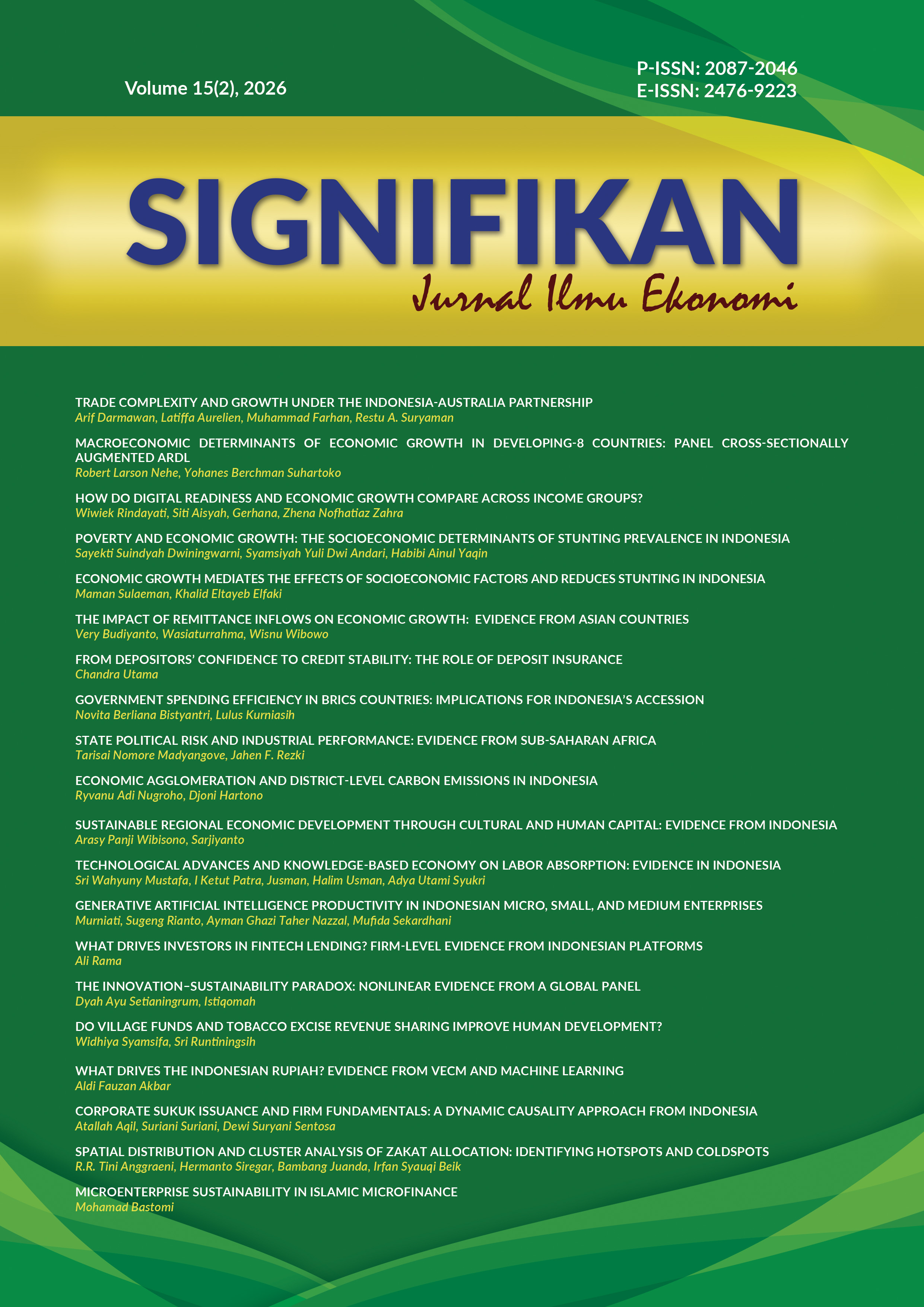
Do Village Funds and Tobacco Excise Revenue Sharing Improve Human Development?
DOI:
https://doi.org/10.15408/sjie.v15i2.51263Keywords:
village funds, tobacco excise revenue sharing, welfare outcomes, intergovernmental fiscal transfers, human developmentAbstract
Research Originality: This study contributes to the literature by examining the effects of Village Funds and Tobacco Excise Revenue Sharing Funds on human development in Central Java and underscores the lack of studies that assess these effects using individual HDI indicators as robustness measures.
Research Objectives: This study aims to analyze whether fiscal transfers significantly improve HDI in Central Java.
Research Methods: This study uses panel data from 35 districts/cities in Central Java during 2016-2023 and employs a Fixed Effects Model. Robustness tests use life expectancy, mean years of schooling, and per capita income.
Empirical Results: Village Funds and Tobacco Excise Revenue Sharing improve human development in Central Java. However, impacts vary by HDI dimension. These fiscal transfer instruments mainly improve life expectancy and income, whereas mean years of schooling show no statistically significant results. This suggests stronger contributions for health and income than for education.
Implications: These findings suggest that fiscal transfer policies should improve targeting and effectiveness to support long-term human development and reduce regional disparities, especially in education outcomes.
JEL Classification: O18, H71, I31, H77, O15
How to Cite:
Syamsyifa, W., & Runtiningsih, S. (2026). Do Village Funds and Tobacco Excise Revenue Sharing Improve Human Development? Signifikan: Jurnal Ilmu Ekonomi, 15(2), 557-570. https://doi.org/10.15408/sjie.v15i2.51263.
References
Ahsan, A., Wiyono, N. H., Amalia, N., Rusdjijati, R., Veruswati, M., Martini, S., Prabandari, Y. S., & Yuniar, A. M. (2024). Early Assessment of Tobacco Excise Sharing Fund as Policy for Farmers’ Viable Alternatives in Indonesia: Case Study of Four Municipalities in Indonesia. Humanities and Social Sciences Communications, 11, 89. https://doi.org/10.1057/s41599-023-02585-y.
Akita, T., Riadi, A. A., & Rizal, A. (2021). Fiscal Disparities in Indonesia in the Decentralization Era: Does General Allocation Fund Equalize Fiscal Revenues? Regional Science Policy and Practice, 13(6), 1842–1865.
Arifin, B., Wicaksono, E., Tenrini, R. H., Wardhana, I. W., Setiawan, H., Damayanty, S. A., Solikin, A., Suhendra, M., Saputra, A. H., Ariutama, G. A., Djunedi, P., Rahman, A. B., & Handoko, R. (2020). Village Fund, Village-Owned Enterprises, and Employment: Evidence from Indonesia. Journal of Rural Studies, 79, 382–394. https://doi.org/10.1016/j.jrurstud.2020.08.052.
Asadullah, M. N., & Savoia, A. (2018). Poverty Reduction During 1990–2013: Did Millennium Development Goals Adoption and State Capacity Matter? World Development, 105, 70–82. https://doi.org/10.1016/j.worlddev.2017.12.010.
Bacarreza, G. C., Vazquez, J. M., & Yedgenov, B. (2020). Identifying and Disentangling the Impact of Fiscal Decentralization on Economic Growth. World Development, 127, 1–15. https://doi.org/10.1016/j.worlddev.2019.104742.
Bekele, M., Sassi, M., Jemal, K., & Ahmed, B. (2024). Human Capital Development and Economic Sustainability Linkage in Sub-Saharan African Countries: Novel Evidence from Augmented Mean Group Approach. Heliyon, 10(2), e24323. https://doi.org/10.1016/j.heliyon.2024.e24323.
Black, J., Connolly, K., Davidson, S. N., & Spowage, M. (2025). The Use and Misuse of Regional Data: Perspectives, Challenges and Policy Implications from Across the UK. Regional Studies, 59(1), 1–16. https://doi.org/10.1080/00343404.2025.2464102.
Guerrero, O. A., Castañeda, G., Trujillo, G., Hackett, L., & Chávez-Juárez, F. (2022). Subnational Sustainable Development: The Role of Vertical Intergovernmental Transfers in Reaching Multidimensional Goals. Socio-Economic Planning Sciences, 83, 101155. https://doi.org/10.1016/j.seps.2021.101155.
Hilmawan, R., Aprianti, Y., Vo, D. T. H., Yudaruddin, R., Bintoro, R. F. A., Fitrianto, Y., & Wahyuningsih, N. (2023). Rural Development from Village Funds, Village-Owned Enterprises, and Village Original Income. Journal of Open Innovation: Technology, Market, and Complexity, 9(4), 100159. https://doi.org/10.1016/j.joitmc.2023.100159.
Hilwa, S., Triandhari, R., & Parianom, R. (2026). Human Development and Income Inequality in D-8 Countries: A Maqashid Sharia Perspective. Signifikan: Jurnal Ilmu Ekonomi, 15(1), 311-326. https://doi.org/10.15408/sjie.v15i1.49355.
Hung, N. T., & Thanh, S. D. (2022). Fiscal Decentralization, Economic Growth, and Human Development: Empirical Evidence. Cogent Economics and Finance, 10(1), 1–17. https://doi.org/10.1080/23322039.2022.2109279.
Jie, Y., & Lan, J. (2024). Dynamic Linkages Between Human Capital, Natural Resources, and Economic Growth – Impact on Achieving Sustainable Development Goals. Heliyon, 10(14), e33536. https://doi.org/10.1016/j.heliyon.2024.e33536.
Jin, H., & Jakovljevic, M. (2023). Fiscal Decentralization and the Human Development Index: A Cross-Border Empirical Study. Sustainability, 15(11), 8784. https://doi.org/10.3390/su15118784.
Lescano, R. M., Gallo, L. M., & Sagales, O. R. (2024). Human Development and Inequalities: The Importance of Social Public Spending. Structural Change and Economic Dynamics, 69, 363–377. https://doi.org/10.1016/j.strueco.2023.12.008.
Lian, X., Fu, Z., & Chen, J. (2023). Analysis of Spatial Differences in Global Regional Human Development Index Under Planetary Pressure and Decomposition Study of Driving Factors. Journal of Environmental Management, 348, 119292. https://doi.org/10.1016/j.jenvman.2023.119292.
Mgammal, M. H. (2024). The Impact of Tobacco Taxes, VAT, and Affordability on the Human Development Index: A Global Perspective on Future Economic Trends. Cogent Economics and Finance, 12(1), 2429771. https://doi.org/10.1080/23322039.2024.2429771.
Pandiangan, A. G., Priyarsono, D. S., & Probokawuryan, M. (2021). Impact of Village Funds on the Gap the Human Development Index in Rural-City Areas in Indonesia. Jurnal Ekonomi dan Kebijakan Pembangunan, 10(2), 134–153. https://doi.org/10.29244/jekp.10.2.2021.134-153.
Permatasari, P., Ilman, A. S., Tilt, C. A., Lestari, D., Islam, S., Tenrini, R. H., Rahman, A. B., Samosir, A. P., & Wardhana, I. W. (2021). The Village Fund Program in Indonesia: Measuring the Effectiveness and Alignment to Sustainable Development Goals. Sustainability, 13(21), 12294. https://doi.org/10.3390/su132112294.
Saputra, D. A., & Doddy, S. (2026). Regional Revenues and Human Development Index: An Empirical Evidence from Indonesia. Revista Brasileira de Gestão e Desenvolvimento Regional, 22(1), 8–29.
Sijabat, R. (2024). Impact of Economic Growth, Village Funds, and Poverty on Human Development in Indonesia: An Analytical Study from 2015 to 2022. International Journal of Advanced and Applied Sciences, 11(3), 250. https://doi.org/10.21833/ijaas.2024.03.023.
Sjaf, S., Malik, A., Sampean, Harits, A., Maulana, S. A. B., Hakim, L., Arsyad, A. A., Gandi, R., Barlan, Z. A., Muhammad, B., Elson, L., & Cakrawinata, F. (2025). Analysis of Spatial Inequality and Rural Development in the Supporting Region for Nusantara Capital City, Indonesia. Wellbeing, Space and Society, 9, 100286. https://doi.org/10.1016/j.wss.2025.100286.
Stijepic, D. (2021). A Cross-Country Study of Skills and Unemployment Flows. Journal for Labour Market Research, 55, 9. https://doi.org/10.1186/s12651-021-00289-x
Suhyanto, O., Juanda, B., Fauzi, A., & Rustiadi, E. (2021). The Effect of Transfer Funds on District/Municipality Development Performance in West Java Province, Indonesia. International Journal of Economics and Financial Issues, 11(3), 22–27. https://doi.org/10.32479/ijefi.9399.
Sultana, T., Dey, S. R., & Tareque, M. (2022). Exploring the Linkage Between Human Capital and Economic Growth: A Look at 141 Developing and Developed Countries. Economic Systems, 46(3), 101017. https://doi.org/10.1016/j.ecosys.2022.101017.
Susilo, S., Prasetyia, F., Wicesa, N. A., & Finuliyah, F. (2026). The Impact of Fiscal Decentralization on Human Development Index Convergence in Indonesia: An Arellano-Bond GMM Dynamic Panel Data Estimation. Forum for Social Economics. https://doi.org/10.1080/07360932.2025.2610937.
Wirandana, P. A., & Khoirunnofik, K. (2022). Educational Inequality in Indonesia: Are Intergovernmental Fiscal Transfers Effective in Reducing the Gap? Educational Studies, 50(6), 1424–1443.
Yandri, P., Budi, S., Sujatna, Y., & Masduki, U. (2020). Revenue Sharing Fund of Tobacco Products Excise and Economic Performance in Decentralized Era. Journal of Governance and Public Policy, 7(2), 104-114. https://doi.org/10.18196/jgpp.72126.
Yimenu, B. (2023). Measuring and Explaining Fiscal De/Centralization: Empirical Evidence from Ethiopia, 1995–2020. Public Administration and Development, 43(3), 245–259. https://doi.org/10.1002/pad.2020.
Yubilianto. (2020). Return to Education and Financial Value of Investment in Higher Education in Indonesia. Journal of Economic Structures, 9, 17. https://doi.org/10.1186/s40008-020-00193-6.
Zhang, J., & Danish. (2019). The Dynamic Linkage Between Information and Communication Technology, Human Development Index, and Economic Growth: Evidence from Asian Economies. Environmental Science and Pollution Research, 26(26), 26982–26990. https://doi.org/10.1007/s11356-019-05926-0.
Downloads
Published
Issue
Section
License
Copyright (c) 2026 Widhiya Syamsyifa, Sri Runtiningsih

This work is licensed under a Creative Commons Attribution-ShareAlike 4.0 International License.