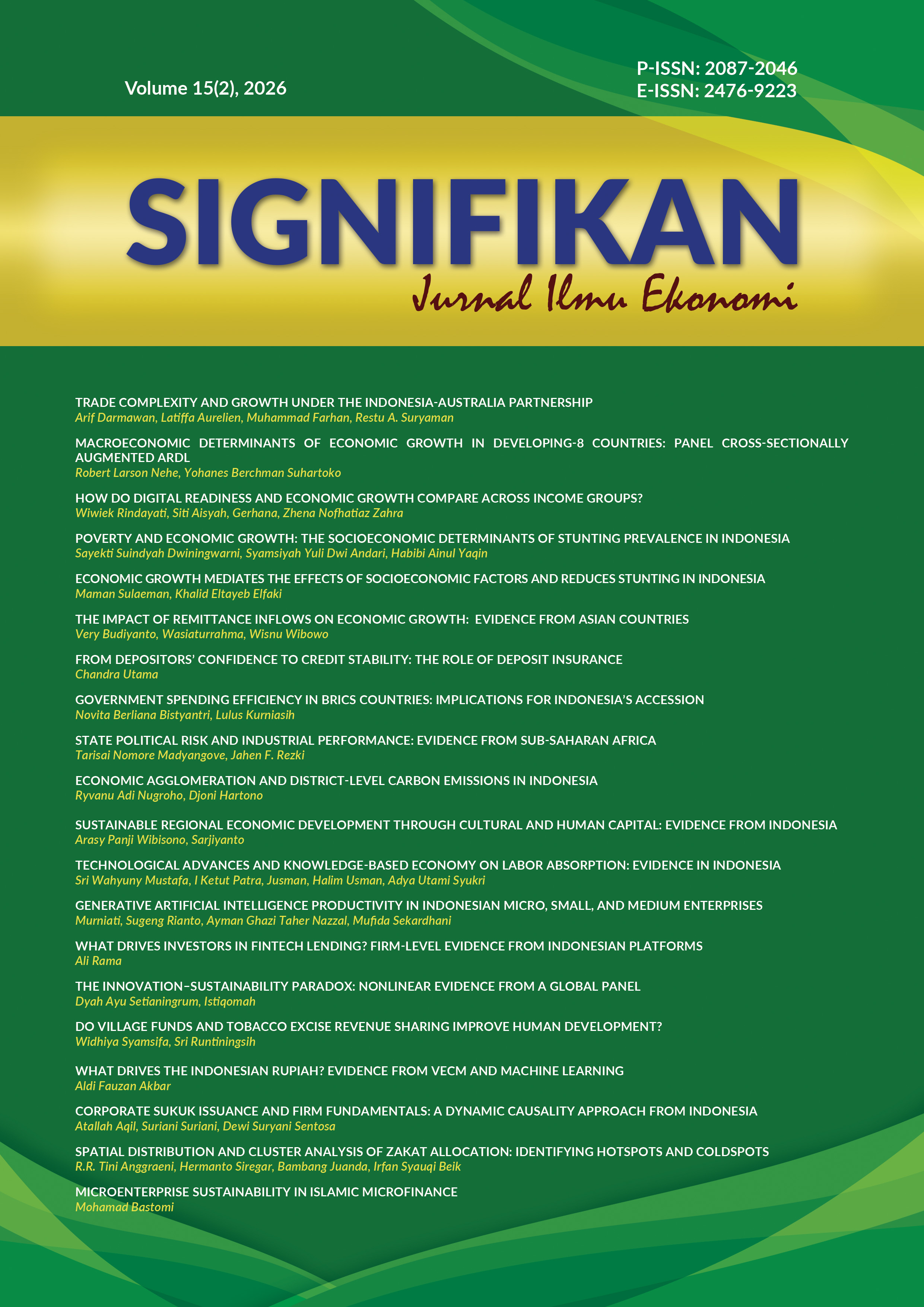
What Drives Investors in Fintech Lending? Firm-Level Evidence from Indonesian Platforms
DOI:
https://doi.org/10.15408/sjie.v15i2.50636Keywords:
Fintech lending , investor participation, platform characteristics, shariah compliance, signaling theoryAbstract
Research Originality: This study offers a novel firm-level perspective on fintech lending by examining platform characteristics, addressing a gap in the literature that has predominantly focused on campaign-level or aggregate data, and extending signaling theory to fintech contexts.
Research Objectives: The study aims to investigate the determinants of investor participation in fintech lending platforms in Indonesia, focusing on platform age, outstanding loan volume, Shariah compliance, and platform scope.
Research Methods: The analysis uses cross-sectional data from 85 licensed fintech lending platforms and applies multiple regression with robust standard errors, controlling for financial performance (ROA, ROE), firm size (assets), and default risk (TWP90).
Empirical Results: The findings indicate that platform age, lending scale, and Shariah compliance positively and significantly influence investor participation, whereas platform scope does not.
Implications: The study highlights the importance of credibility, scale, and ethical positioning in attracting investors. It provides insights for platform operators to strengthen trust and for regulators to enhance transparency and stability, supporting the development of a sustainable fintech lending ecosystem.
JEL Classification: G23, G41, D82
How to Cite:
Rama, A. (2026). What Drives Investors in Fintech Lending? Firm-Level Evidence from Indonesian Platforms. Significan; Jurnal Ilmu Ekonomi, 15(2), 531-542. https://doi.org/10.15408/sjie.v15i2.50636.
References
Ahmed, Q. N., & Sharif, S. (2023). Who Gets Believed? Trust and Investor Reaction to Earnings Announcements in Sharīʿah-Compliant vs. Sharīʿah Non-Compliant Firms. ISRA International Journal of Islamic Finance, 15(1), 4–21. https://doi.org/10.55188/ijif.v15i1.482.
Basha, S. A., Elgammal, M. M., & Abuzayed, B. M. (2021). Online Peer-to-Peer Lending: A Review of the Literature. Electronic Commerce Research and Applications, 48, 101069. https://doi.org/10.1016/j.elerap.2021.101069.
Cai, C. W. (2018). Disruption of Financial Intermediation by FinTech: A Review on Crowdfunding and Blockchain. Accounting and Finance, 58(4), 965–992. https://doi.org/10.1111/acfi.12405.
Chakraborty, D., Gupta, N., Mahakud, J., & Tiwari, M. K. (2023). Corporate Governance and Investment Decisions of Retail Investors in Equity: Do Group Affiliation and Firm Age Matter? Managerial Auditing Journal, 38(1), 1–34. https://doi.org/10.1108/MAJ-06-2021-3177.
Chen, X., Huang, B., & Shaban, M. (2020). Naïve or Sophisticated? Information Disclosure and Investment Decisions in Peer-to-Peer Lending. Journal of Corporate Finance, 77, 101805. https://doi.org/10.1016/j.jcorpfin.2020.101805.
Claessens, S., Frost, J., Turner, G., & Zhu, F. (2018). Fintech Credit Markets Around the World: Size, Drivers and Policy Issues. BIS Quarterly Review September.
Cornelli, G., Frost, J., Gambacorta, L., Rau, P. R., Wardrop, R., & Ziegler, T. (2023). Fintech and Big Tech Credit: Drivers of the Growth of Digital Lending. Journal of Banking & Finance, 148, 106742. https://doi.org/10.1016/j.jbankfin.2022.106742.
Del Sarto, N. (2024). Exploring Peer-to-Peer Lending: Key Influences of Firm Uncertainty, Loan Features and Venture Quality. International Journal of Bank Marketing, 43(3), 591–614. https://doi.org/10.1108/IJBM-04-2024-0239.
Foo, J., Lim, L.-H., & Wong, K. S.-W. (2017). Macroeconomics and FinTech: Uncovering Latent Macroeconomic Effects on Peer-to-Peer Lending. ArXiv Preprint ArXiv:1710.11283.
Gao, J. (2022). Comparison of Fintech Development between China and the United States. International Journal of Innovative Science and Research Technology (IJISRT), 7(4), 1150-1155. https://doi.org/10.5281/zenodo.6563524.
Ge, R., Feng, J., Gu, B., & Zhang, P. (2017). Predicting and Deterring Default with Social Media Information in Peer-to-Peer Lending. Journal of Management Information Systems, 34(2), 401–424. https://doi.org/10.1080/07421222.2017.1334472.
Gu, D., Gui, Z., & Huang, Y. (2026). Fintech Market and Regulation: Lessons from China’s Peer-to-Peer Lending Platforms. Journal of Corporate Finance, 98, 102969. https://doi.org/10.1016/j.jcorpfin.2026.102969.
Ha, D., Le, P., & Nguyen, D. K. (2025). Financial Inclusion and Fintech: A State-of-the-Art Systematic Literature Review. Financial Innovation, 11(1), 69. https://doi.org/10.1186/s40854-024-00741-0.
Herzenstein, M., Dholakia, U. M., & Andrews, R. L. (2011). Strategic Herding Behavior in Peer-to-Peer Loan Auctions. Journal of Interactive Marketing, 25(1), 27–36. https://doi.org/10.1016/j.intmar.2010.07.001.
Hettler, F. M., Hammer, J., & Teuteberg, F. (2025). Unraveling User Perception of Peer-to-Peer Lending Platforms: A Triangulated Mixed-Methods Approach. Electronic Commerce Research. https://doi.org/10.1007/s10660-025-10053-9.
Hodula, M. (2022). Does Fintech Credit Substitute for Traditional Credit? Evidence from 78 Countries. Finance Research Letters, 46(B), 102469. https://doi.org/10.1016/j.frl.2021.102469.
Hughes, J. P., Jagtiani, J., & Moon, C.-G. (2022). Consumer Lending Efficiency: Commercial Banks versus a Fintech Lender. Financial Innovation, 8(1), 38. https://doi.org/10.1186/s40854-021-00326-1.
Iyer, R., Khwaja, A. I., Luttmer, E. F. P., & Shue, K. (2016). Screening Peers Softly: Inferring the Quality of Small Borrowers. Management Science, 62(6), 1554–1577.
Jagtiani, J., & Lemieux, C. (2018). Do Fintech Lenders Penetrate Areas that Are Underserved by Traditional Banks? Journal of Economics and Business, 100, 43–54. https://doi.org/10.1016/j.jeconbus.2018.03.001.
Jiang, C., Xu, Q., Zhang, W., Li, M., & Yang, S. (2018). Does Automatic Bidding Mechanism Affect Herding Behavior? Evidence from Online P2P Lending in China. Journal of Behavioral and Experimental Finance, 20, 39–44. https://doi.org/10.1016/J.JBEF.2018.07.001.
Korniotis, G. M., & Kumar, A. (2011). Do Older Investors Make Better Investment Decisions? The Review of Economics and Statistics, 93(1), 244–265.
Lee, E., & Lee, B. (2012). Herding Behavior in Online P2P Lending: An Empirical Investigation. Electronic Commerce Research and Applications, 11(5), 495–503. https://doi.org/10.1016/j.elerap.2012.02.001
Oseni, U. A., & Ali, S. N. (2019). Fintech in Islamic Finance: An Introduction. In Oseni, U. A., & Ali, S. N. (Eds.), Fintech in Islamic finance: Theory and Practice, pp. 4–15. New York: Routledge.
Rama, A., Ali, H., & Syafruddin, S. (2026). Enhancing Charitable Crowdfunding Performance: The Role of Signaling Information. Management Decision, 1–20. https://doi.org/10.1108/MD-07-2024-1726
Rama, A., Jiang, C., Johan, S., Liu, H., & Mai, Y. (2022). Religious and Social Narratives and Crowdfunding Success. Journal of International Financial Markets, Institutions and Money, 80, 101595. https://doi.org/10.1016/j.intfin.2022.101595.
Rama, A., & Yaman, B. (2024). Islamic Crowdfunding and Social Entrepreneurship: The Effect of Organizational Orientation Rhetoric on Crowdfunding Success. Journal of Social Entrepreneurship, 16(3), 1711-1736. https://doi.org/10.1080/19420676.2024.2326128.
Sheng, T. (2021). The Effect of Fintech on Banks’ Credit Provision to SMEs: Evidence from China. Finance Research Letters, 39, 101558. https://doi.org/10.1016/j.frl.2020.101558.
Sidaoui, M., Ben Bouheni, F., Arslankhuyag, Z., & Mian, S. (2022). Fintech and Islamic Banking Growth: New Evidence. The Journal of Risk Finance, 23(5), 535–557. https://doi.org/10.1108/JRF-03-2022-0049.
Spence, M. (1973). Job Market Signaling. The Quarterly Journal of Economics, 87(3), 355–374. https://doi.org/10.2307/1882010.
Tawfik, O. I., Elmaasrawy, H. E., & Hussainey, K. (2025). The Impact of Sharia Compliance on Attracting Investments: Empirical Evidence from GCC. International Journal of Islamic and Middle Eastern Finance and Management, 18(1), 23–48. https://doi.org/10.1108/IMEFM-02-2024-0060.
Yang, C.-S., & Shyu, J. (2019). Do Institutional Investor and Group, Firm and Time Effects Matter in Enterprise Performance in the Corporate Life Cycle? Cogent Business & Management, 6(1), 1606473. https://doi.org/10.1080/23311975.2019.1606473.
Zhang, J., & Liu, P. (2012). Rational Herding in Microloan Markets. Management Science, 58(5), 892–912.
Downloads
Published
Issue
Section
License
Copyright (c) 2026 Ali Rama

This work is licensed under a Creative Commons Attribution-ShareAlike 4.0 International License.