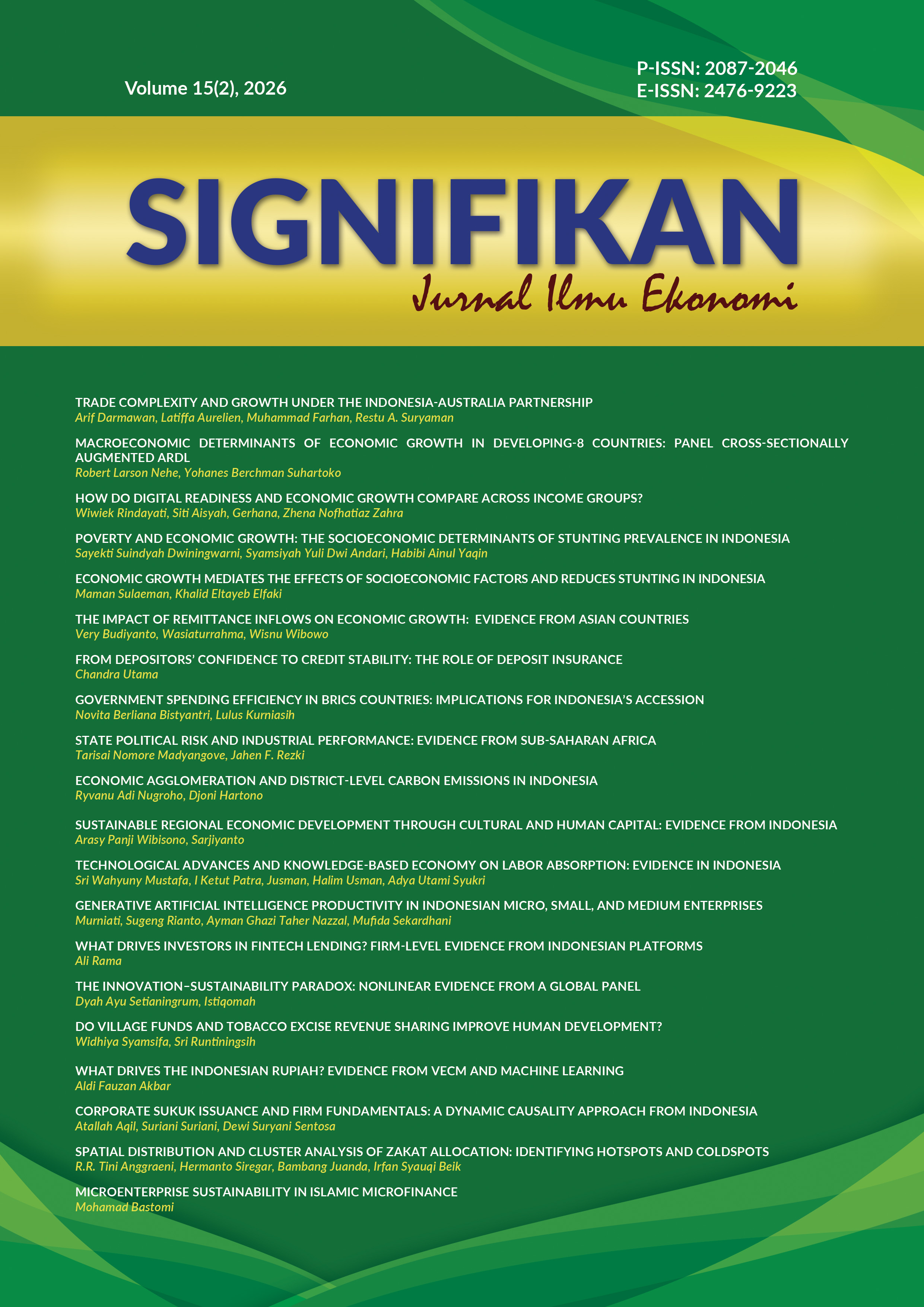
Poverty and Economic Growth: The Socioeconomic Determinants of Stunting Prevalence in Indonesia
DOI:
https://doi.org/10.15408/sjie.v15i2.50601Keywords:
parental education level, open unemployment rate, path analysis, child health, social problemAbstract
Research Originality: This study provides recent provincial evidence from Indonesia (2010–2024) on the nexus between poverty, economic growth, and stunting.
Research Objectives: This study aims to investigate the effects of poverty and economic growth on stunting prevalence in Indonesia, using parental education level and the open unemployment rate as proxies.
Research Methods: This study employs path analysis using a natural-log approach, analyzing data from 2000 to 2023. Key variables include socioeconomic determinants and stunting prevalence.
Empirical Results: The findings of this study include: poverty has a negative and significant effect on parental education and open unemployment, while economic growth has no significant effect on parental education and open unemployment; poverty affects the prevalence of stunting through parental education and open unemployment, while economic growth does not affect the prevalence of stunting through parental education and open unemployment.
Implications: The findings suggest that reducing stunting requires inclusive economic growth and effective poverty alleviation. Therefore, policies should focus on strengthening social protection and improving access to nutrition and health services.
JEL Classification: I21, E24, C32, I10, I31
How to Cite:
Dwiningwarni, S S., Andari, S. Y. D., & Yaqin, H. A. (2026). Poverty and Economic Growth: The Socioeconomic Determinants of Stunting Prevalence in Indonesia. Signifikan: Jurnal Ilmu Ekonomi, 15(2), 373-390. https://doi.org/10.15408/sjie.v15i2.50601.
References
Alemu, T. G., Fentie, E. A., Belay, D. G., Asmamaw, D. B., Shewarega, E. S., Negash, W. D., Eshetu, H. B., Aragaw, F. M., Fetene, S. M., & Teklu, R. E. (2025). Socioeconomic Inequality in the Co-Occurrence of Anemia and Stunting Among Adolescent Girls aged 15–19 Years in Sub-Saharan African Countries: A Decomposition Analysis. BMC Public Health, 25(1), 1–10. https://doi.org/10.1186/s12889-025-21841-1.
Apriyanti, C., & Yanuarti, M. (2024). Analysis of the Determinants of Open Unemployment Rate: The Role of Human Development Index and Socioeconomic Factors. Journal of Economics, Management, Accounting and Computer Applications, 1(2), 27–31. https://doi.org/10.69693/jemaca.v1i2.13.
Arief, Y. S., Yunita, F. C., Efendi, F., Murti, F. A. K., Pradipta, R. O., & McKenna, L. (2025). Social and Environmental Determinants of Childhood Stunting in Indonesia: National Cross-Sectional Study. JMIR Pediatrics and Parenting, 8, e68918. https://doi.org/10.2196/68918.
Astuti, S. J. W., Dwiningwarni, S. S., & Atmojo, S. (2025). Modeling Environmental Interactions and Collaborative Interventions for Childhood Stunting: A Case from Indonesia. Dialogues in Health, 6, 1–11. https://doi.org/10.1016/j.dialog.2025.100206.
Aswi, A., Rahardiantoro, S., Kurnia, A., Sartono, B., Handayani, D., & Nurwan, N. (2025). Bayesian Spatio-Temporal Conditional Autoregressive Localized Modeling Techniques for Socioeconomic Factors and Stunting in Indonesia. MethodsX, 15. https://doi.org/10.1016/j.mex.2025.103464.
Aureli, S. R., & Juliprijanto, W. (2022). Influence of Income Inequality, Economic Growth, and Unemployment on Indonesian Poverty in 1992-2019. Journal Of Management, Accounting, General Finance and International Economic Issues (MARGINAL), 2(1), 51–67.
Ayue, H. I., Nurdiana, N., Wardhani, V., Astuti, A. B., Prayitno, H., Laksono, A. D., & Sundjaya, T. (2025). Exploring the Multifactorial Predictors of Stunting in Children Under Five: A Systematic Review of the Literature, 2015–2024. Journal of Public Health Research, 14(4), 1–15. https://doi.org/10.1177/22799036251403945.
Baliwati, Y. F., & Rusyda, A. L. (2025). Food Resources Management and Multilevel Determinants of Stunting: Insights from a National Socio-Ecological Analysis in Indonesia. Malaysian Journal of Nutrition, 31(2), 305–319. https://doi.org/10.31246/mjn-2025-0012.
Beal, T., Tumilowicz, A., Sutrisna, A., Izwardy, D., & Neufeld, L. M. (2018a). A review of child stunting determinants in Indonesia. Maternal and Child Nutrition, 14(4), 1–10. https://doi.org/10.1111/mcn.12617.
Brychka, B., Vyslobodska, H., & Voitovych, N. (2023). Poverty in Ukraine: Evolution of Interpreting And Analysis of Impact Factors. Agricultural and Resource Economics: International Scientific E-Journal, 9(2), 5–33.
Cameron, L., Chase, C., Haque, S., Joseph, G., Pinto, R., & Wang, Q. (2021). Childhood Stunting and Cognitive Effects of Water And Sanitation in Indonesia. Economics and Human Biology, 40, 1–40. https://doi.org/10.1016/j.ehb.2020.100944
Carneiro, P., Cattan, S., & Neves, H. (2025). Theoretical and Empirical Perspectives on the Link Between Poverty, Parenting, and Children’s Outcomes. Fiscal Studies, 46(1), 9–35. https://doi.org/10.1111/1475-5890.12404.
Choi, S., & Min, I. (2024). Parental Socioeconomic Status and Adolescent Development in Indonesia. International Journal of Adolescence and Youth, 29(1), 1–15. https://doi.org/10.1080/02673843.2024.2387086.
Dwiningwarni, S. S., Aslichah, A., Ariyanto, A., Titin, T., & Yusuf, M. (2019). Population, Unemployment, and Poverty: A Population Analysis in East Java, Indonesia. Proceedings of the 1st Sampoerna University-AFBE International Conference, SU-AFBE 2018, 6-7 December 2018, Jakarta, Indonesia, 04(09), 6–8. https://doi.org/10.4108/eai.6-12-2018.2286278
Elmira, E. S., & Qaim, M. (2026). Macroeconomic Shocks and Long-term Nutritional Outcomes: Insights from the Asian Financial Crisis. Global Food Security, 48, 100900. https://doi.org/10.1016/j.gfs.2025.100900
Galasso, E., & Wagstaff, A. (2019). The aggregate income losses from childhood stunting and the returns to a nutrition intervention aimed at reducing stunting. Economics and Human Biology, 34, 225–238. https://doi.org/10.1016/j.ehb.2019.01.010
Gebregergis, C. M. (2024). Socioeconomic determinants of child malnutrition: Evidence from Ethiopia. Discover Global Society, 2(1), 1–22. https://doi.org/10.1007/s44282-024-00062-8
Haider, A., Jabeen, S., Rankaduwa, W., & Shaheen, F. (2023). The Nexus between Employment and Economic Growth: A Cross-Country Analysis. Sustainability (Switzerland), 15(15), 1–18. https://doi.org/10.3390/su151511955
Hamzah, M. Z., Sofilda, E., & Kusairi, S. (2025). How do socioeconomic indicators and fiscal decentralization affect stunting? Evidence from Indonesia. International Journal of Development Issues, 24(2), 264–281. https://doi.org/10.1108/IJDI-05-2024-0150
Handoko, W., Sulaiman, A. I., Sugito, T., & Sabiq, A. (2024). Empowering Former Women Migrant Workers: Enhancing SocioEconomic Opportunities and Inclusion for Sustainable Development. Academic Journal of Interdisciplinary Studies, 13(1), 199–210. https://doi.org/10.36941/ajis-2024-0015
Harvey, C. M., Newell, M. L., & Padmadas, S. (2022). Maternal Socioeconomic Status and Infant Feeding Practices Underlying Pathways to Child Stunting in Cambodia: Structural Path Analysis Using Cross-Sectional Population Data. BMJ Open, 12(11), 055853. https://doi.org/10.1136/bmjopen-2021-055853.
Hornok, C., & Raeskyesa, D. G. S. (2024). Economic Zones and Local Income Inequality: Evidence from Indonesia. Journal of Economic Inequality, 22(1), 69–100. https://doi.org/10.1007/s10888-023-09581-x.
Ijaiya, M. A., Anjorin, S., & Uthman, O. A. (2024a). Income and Education Disparities in Childhood Malnutrition: A Multi-Country Decomposition Analysis. BMC Public Health, 24(1), 1–15. https://doi.org/10.1186/s12889-024-20378-z.
Jamil, B., Yaping, S., Ud Din, N., & Nazneen, S. (2022). Do Effective Public Governance and Gender (in)equality Matter for Poverty? Economic Research-Ekonomska Istrazivanja , 35(1), 158–174. https://doi.org/10.1080/1331677X.2021.1889391.
Jinuntuya, P., & Jinuntuya, N. (2025). Error Analysis of the Path-Finding Algorithm Applied to the Variational Problem. Journal of Physics: Conference Series, 3168(1), 012015. https://doi.org/10.1088/1742-6596/3168/1/012015.
Jumhur, J. (2024). The Effect of Economic Growth and Poverty on Stunting in Indonesia. Jurnal Perspektif Pembiayaan dan Pembangunan Daerah, 11(6), 433–448. https://doi.org/10.22437/ppd.v11i6.26871.
Kalinda, C., Phri, M., Albin Qambayot, M., Consolatrice Sage Ishimwe, M., Gebremariam, A., Bekele, A., & Wong, R. (2023). Socio-Demographic and Environmental Determinants of Under-Stunting in Rwanda: Evidence From A Multisectoral Study. Frontiers in Public Health, 11, 1–13. https://doi.org/10.3389/fpubh.2023.1107300.
Kawashita, I. W. R., & Marseto, M. (2024). Analysis of the Influence of Open Unemployment Rate, Poverty Rate, and Economic Growth on the Human Development Index in Sleman Regency. East Asian Journal of Multidisciplinary Research, 2(12), 5069–5078. https://doi.org/10.55927/eajmr.v2i12.7320.
Kirana, A. D., & Nilasari, A. (2025). The Effect of Economic Growth Rate, Human Development Index, and Open Unemployment Rate on Poverty in East Java Province 2019-2023. Formosa Journal of Multidisciplinary Research, 4(3), 1079–1094. https://doi.org/10.55927/fjmr.v4i3.97.
Kustanto, A. (2021a). The Prevalence of Stunting, and Economic Growth In Indonesia: A Panel Data Dynamic Causality Analysis. Journal of Developing Economies, 6(2), 150. https://doi.org/10.20473/jde.v6i2.22358.
Laksono, A. D., Wulandari, R. D., Amaliah, N., & Wisnuwardani, R. W. (2022). Stunting Among Children Under Two Years in Indonesia: Does Maternal Education Matter? PLoS ONE, 17(7), 1. https://doi.org/10.1371/journal.pone.0271509.
Li, J., Xue, E., Wei, Y., & He, Y. (2024). How Popularising Higher Education Affects Economic Growth and Poverty Alleviation: Empirical Evidence from 38 Countries. Humanities and Social Sciences Communications, 11(1), 1–11. https://doi.org/10.1057/s41599-024-03013-5.
Lumbantoruan, D., & Azansyah, A. (2024). The Effect of the Number of Poor People, the Rate of Economic Growth, and the Level of Education on the Number of Stunting on the Island of Sulawesi. Indonesian Journal of Banking and Financial Technology, 2(4), 291–308. https://doi.org/10.55927/fintech.v2i4.12035.
Margettyaningsih., Suryanto., & Gravitiani, E. (2024). Socio-Economic Indicator of Childhood Stunting in Indonesia: A GMM Analysis. Efficient: Indonesian Journal of Development Economics, 7(3), 276–284. https://doi.org/10.15294/tmcxwt62.
Matovu, N., Kizito, N., & Aljohani, M. (2026). Understanding household economic influences on child stunting: A cross-sectional study in Eastern Uganda. Nutrition, 147, 1–7. https://doi.org/10.1016/j.nut.2026.113187
Mauro, J. A. (2025). The Effects of Intergenerational Income Mobility and Per-Pupil Education Spending on Economic Growth. Cogent Economics and Finance, 13(1), 1–28. https://doi.org/10.1080/23322039.2025.2521465.
Momo, M. S. M., Cabus, S. J., & Groot, W. (2021). Household Deprivation and The Intergenerational Correlation of Education: An Analysis of Developing Countries. International Journal of Educational Research, 109, 1–17. https://doi.org/10.1016/j.ijer.2021.101797.
Mudd, A. L., van Lenthe, F. J., Verra, S. E., Bal, M., & Kamphuis, C. B. M. (2021). Socioeconomic Inequalities in Health Behaviors: Exploring Mediation Pathways Through Material Conditions and Time Orientation. International Journal for Equity in Health, 20(1). https://doi.org/10.1186/s12939-021-01522-2.
Mulyaningsih, T., Mohanty, I., Widyaningsih, V., Gebremedhin, T. A., Miranti, R., & Wiyono, V. H. (2021). Beyond Personal Factors: Multilevel Determinants of Childhood Stunting in Indonesia. PLoS ONE, 16(11), 1–19. https://doi.org/10.1371/journal.pone.0260265.
Olakunle, A. A. (2024). Analyzing the Drivers of Stunting Reduction in Twelve Sub-Saharan African Countries Using The RIF Decomposition Approach. BMC Public Health, 24(1), 1–12. https://doi.org/10.1186/s12889-024-19327-7.
Oriaku Emordi, A. T. (2024). Culture and Poverty: Exploring Gender Inclusiveness for Successful Poverty Alleviation Programs in Nigeria. Humanus Discourse, 4(2), 1–19.
Otten, R., & Ha, T. (2024). Towards a Better Understanding of Inequity and the Psychological Processes Underlying The Intergenerational Transmission Of Socioeconomic Status. Social Science and Medicine, 360, 1–8. https://doi.org/10.1016/j.socscimed.2024.117330.
Puja Ilham, A. (2023). The Effect of Natural Disaster on Regional Economic Growth, Unemployment, Poverty, and Human Development Index in Thirty Indonesian Provinces. Journal of Indonesian Applied Economics, 11(1), 40–59. https://doi.org/10.21776/ub.jiae.2023.011.01.4.
Purba, E. F., Nopeline, N., & Anjelina Gea, P. (2024). Analysis of The Influence of Economic Growth, Open Unemployment Rate, and The Percentage of Poor Population on HDI North Sumatera City Regency, 2010 - 2022. Jurnal Ilmu Sosial Mamangan, 12(3), 2503–1570. https://doi.org/10.22202/mamangan.v12i03.7894.
Putri, A. K., & Budiarty, I. (2026). Female Education, Poverty, and Household Factors in Reducing Stunting in Indonesia. International Journal of Economics and Management Sciences, 3(2), 185–198. https://doi.org/10.61132/ijems.v3i2.1217.
Rogna, M. (2024). The Contribution of Agricultural Inputs in Reducing Child Stunting. Agriculture and Food Security, 13(1), 1–13. https://doi.org/10.1186/s40066-024-00503-2.
Saidu, S. F., & Danielson, R. A. (2024). Social Determinants of Health Associated with Increased Prevalence Of Childhood Malnutrition in Africa. Frontiers in Nutrition, 11. https://doi.org/10.3389/fnut.2024.1456089
Sarstedt, M., Ringle, C. M., & Hair, J. F. (2021). Partial Least Squares Structural Equation Modeling. In Homburg, C., Klarmann, M., & Vomberg, A (Eds). Handbook of Market Research (pp. 1–47). Berlin: Springer International Publishing.
Selvanus., Syafril., As-Syahri, H., Susanto, H., Wahyudi., & Syaifullah. (2024). Path Analysis of Factors that Influence Students in Choosing a Study Program to Get to Their Dream Job. Jurnal Ekonomi, 13(1), 740–755. https://doi.org/DOI10.54209/ekonomi.v13i01.
Siramaneerat, I., Astutik, E., Agushybana, F., Bhumkittipich, P., & Lamprom, W. (2024a). Examining Determinants of Stunting in Urban and Rural Indonesian: A Multilevel Analysis Using the Population-Based Indonesian Family Life Survey (IFLS). BMC Public Health, 24(1). https://doi.org/10.1186/s12889-024-18824-z
Sosu, E. M., Mtika, P., Pimenta, S. M., Nyarko, N. Y., Fleischer-Djoleto, D., Wilson, C., Maulidi, F., & Mepenedo, I. (2026). Understanding Pathways to Low Educational Attainment: A Multidimensional Poverty and Educational Achievement Model. International Journal of Educational Development, 120, 1–11. https://doi.org/10.1016/j.ijedudev.2025.103457.
Ssentongo, P., Ssentongo, A. E., Ba, D. M., Ericson, J. E., Na, M., Gao, X., Fronterre, C., Chinchilli, V. M., & Schiff, S. J. (2021). Global, Regional and National Epidemiology And Prevalence of Child Stunting, Wasting, and Underweight in Low- And Middle-Income Countries, 2006–2018. Scientific Reports, 11(1), 1–12. https://doi.org/10.1038/s41598-021-84302-w.
Supadmi, S., Laksono, A. D., Kusumawardani, H. D., Ashar, H., Nursafingi, A., Kusrini, I., & Musoddaq, M. A. (2024a). Factors Related to Stunting of Children Under Two Years with Working Mothers in Indonesia. Clinical Epidemiology and Global Health, 26, 1–6. https://doi.org/10.1016/j.cegh.2024.101538.
Suparman, S., & Muzakir, M. (2023). Regional Inequality, Human Capital, Unemployment, and Economic Growth in Indonesia: Panel Regression Approach. Cogent Economics and Finance, 11(2), 1–14. https://doi.org/10.1080/23322039.2023.2251803.
Wand, H., Naidoo, S., Govender, V., Reddy, T., & Moodley, J. (2024). Preventing Stunting in South African Children Under 5: Evaluating the Combined Impacts of Maternal Characteristics and Low Socioeconomic Conditions. Journal of Prevention, 45(3), 339–355. https://doi.org/10.1007/s10935-024-00766-2.
Wang, Y., Chen, Y., & Li, Z. (2024). Escaping Poverty: Changing Characteristics of China’s Rural Poverty Reduction Policy and Future Trends. Humanities and Social Sciences Communications, 11(1), 694. https://doi.org/10.1057/s41599-024-03204-0.
Widyaningsih, V., Mulyaningsih, T., Rahmawati, F. N., & Adhitya, D. (2022). Determinants of Socioeconomic and Rural-Urban Disparities in Stunting: Evidence from Indonesia. Rural and Remote Health, 22(1), 1–9. https://doi.org/10.22605/RRH7082.
Wu, Y., Muddassir, S. M., Naqvi, A., & Yasin, I. (2022). Dynamic Relationship between Social Factors and Poverty: A Panel Data Analysis of 23 Selected Developing Countries. Journal of the Knowledge Economy, 15, 19354–19386. https://doi.org/10.1007/s13132-024-01843-x.
Yaya, S., Uthman, O. A., Kunnuji, M., Navaneetham, K., Akinyemi, J. O., Kananura, R. M., Adjiwanou, V., Adetokunboh, O., & Bishwajit, G. (2020a). Does Economic Growth Reduce Childhood Stunting? A Multicountry Analysis of 89 Demographic and Health Surveys in Sub-Saharan Africa. BMJ Global Health, 5(1), 1–8. https://doi.org/10.1136/bmjgh-2019-002042.
Downloads
Published
Issue
Section
License
Copyright (c) 2026 Sayekti Suindyah Dwiningwarni, Syamsiyah Yuli Dwi Andari, Habibi Ainul Yaqin

This work is licensed under a Creative Commons Attribution-ShareAlike 4.0 International License.